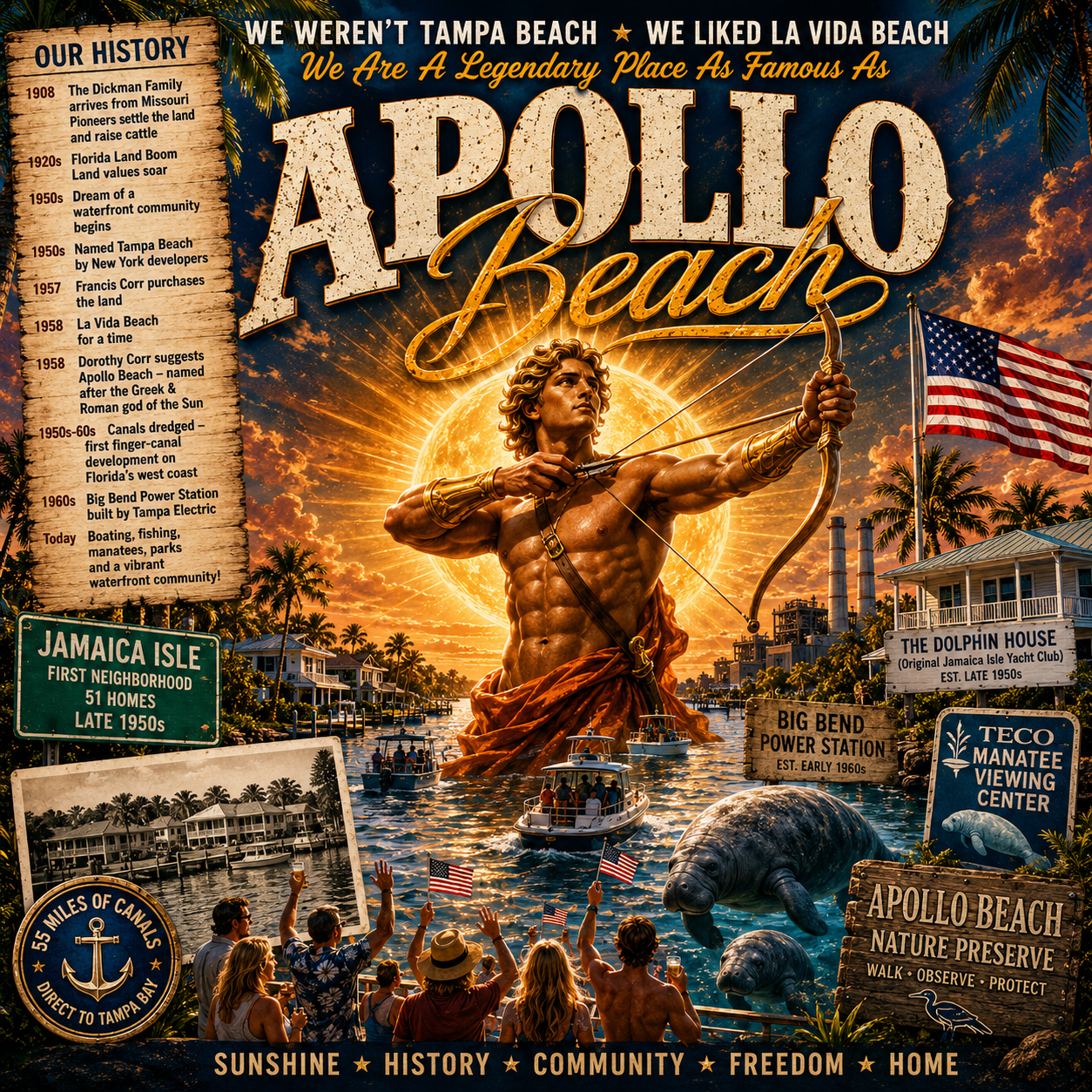
Apollo Beach: From Frontier Ranchland to Florida's Waterfront Paradise
A Fourth of July Celebration of History, Heritage, Innovation, and Community Pride
When people think of Apollo Beach today, they picture boats tied behind homes, dolphins swimming through backyard canals, families watching spectacular sunsets over Tampa Bay, and one of Florida's most welcoming waterfront communities. Yet just over a century ago, none of this existed.
Apollo Beach wasn't built around a river or natural harbor.
It was imagined.
It was engineered.
It was created from the vision of pioneering families who believed that Florida's Gulf Coast could become something extraordinary.
The Dickman Family: The Beginning of Apollo Beach
Apollo Beach's story begins with one of South Hillsborough County's earliest pioneer families.
In 1908, eleven-year-old Paul Dickman arrived in Florida from Missouri with his parents, A.P. and Rose Dickman. They settled on thousands of acres along Tampa Bay that consisted of pine forests, marshland, mangroves, palmettos, and open grazing land. There were no paved roads, bridges, neighborhoods, or marinas—only wilderness.
The Dickmans farmed the land, raised cattle, and slowly built their lives in an area few people could imagine becoming a thriving coastal community.
By the early 1920s, the family owned approximately 5,500 acres along Tampa Bay. Before the Great Depression, Paul Dickman began imagining something few others could see—not simply farmland, but an entirely new waterfront community where every family could enjoy life on the water.
It was a vision decades ahead of its time.
Florida's Great Land Boom
Like much of Florida, the property experienced explosive growth during the land boom of the 1920s.
Land values climbed from $30 an acre to $60, then $125, eventually reaching nearly $600 per acre before the boom collapsed.
Paul Dickman later described those years as a "paper boom," when fortunes appeared to be made almost overnight through land contracts and speculation.
When the market crashed, development came to a halt, leaving the Dickman property largely untouched for another generation.
From Tampa Beach to Apollo Beach
Following World War II, Florida experienced another wave of growth.
In the early 1950s, New York developers partnered with the Dickman family to begin dredging canals and creating waterfront home sites under the name Tampa Beach.
The ambitious project stalled when financing ran out, leaving unfinished canals and unrealized dreams.
Everything changed in 1957 when Michigan developer Francis Corr purchased the property.
Corr briefly renamed the community La Vida Beach, but the name never truly reflected the vision he had for the area.
Then, in 1958, his wife Dorothy Corr suggested a name inspired by the greatest natural feature the community possessed—the brilliant Florida sunshine.
She chose Apollo, the Greek and Roman god of the sun.
Apollo Beach was born.
The First Finger Canal Community on Florida's Gulf Coast
Francis Corr didn't simply build another subdivision.
He helped pioneer one of the first finger-canal waterfront developments on Florida's west coast.
Using massive dredges, workers excavated canals while using the removed material to build elevated "fingers" of land where homes could safely be constructed above sea level.
The result transformed thousands of acres of mangrove shoreline into one of Florida's most unique residential boating communities.
Today, Apollo Beach boasts approximately 55 miles of navigable canals, allowing residents to step from their backyards onto their boats and reach Tampa Bay within minutes.
Those canals remain the community's defining landmark and one of the greatest engineering achievements in Hillsborough County's residential history.
The Dolphin House: Where Apollo Beach Began
Among Apollo Beach's most treasured historic landmarks is The Dolphin House.
Originally built as the Jamaica Isle Yacht Club, it served the very first neighborhood developed by the Corr family.
Known as Jamaica Isle, the original subdivision consisted of just 51 waterfront homes, making it the birthplace of modern Apollo Beach.
The former yacht club became known locally as The Dolphin House and remains one of the few surviving structures connected to the community's earliest days.
For longtime residents, it represents where the Apollo Beach story truly began.
Powering Tampa Bay
In the early 1960s, the Flora Sun Corporation sold the northern portion of the property to Tampa Electric Company for construction of what would become the Big Bend Power Station.
The enormous facility quickly became Apollo Beach's most recognizable landmark, visible for miles across Tampa Bay.
Its towering stacks have become part of the community's skyline for generations.
Yet its greatest legacy wasn't intended.
The Manatees Choose Apollo Beach
The warm-water discharge from the Big Bend Power Station created ideal winter habitat for endangered West Indian manatees.
Every winter, hundreds gather in the warm canal waters when temperatures drop throughout Tampa Bay.
To protect this incredible natural phenomenon, the TECO Manatee Viewing Center was established.
Today, it welcomes visitors from around the world who come to witness one of Florida's greatest wildlife experiences.
The center has become synonymous with Apollo Beach and serves as a reminder that industry and conservation can sometimes create unexpected partnerships.
Championship Golf Comes to Apollo Beach
Apollo Beach's reputation continued growing with the development of the Apollo Beach Golf Club.
The 18-hole championship course was designed by legendary golf architect Robert Trent Jones Sr., whose portfolio includes more than 500 golf courses across 40 states and 35 countries.
Having one of Jones' original designs gives Apollo Beach a place in golf history and has attracted players from across the region for decades.
Protecting the Natural Coast
While canals reshaped much of the shoreline, Apollo Beach has never forgotten its natural heritage.
The Apollo Beach Nature Preserve, located along Surfside Boulevard, preserves native coastal habitat while offering visitors scenic walking trails, observation towers overlooking Tampa Bay, picnic areas, and opportunities to observe dolphins, shorebirds, and spectacular Gulf Coast sunsets. The preserve map highlights the entrance, walking trail, observation tower, and restoration areas dedicated to protecting sensitive coastal ecosystems.
Apollo Beach Today
Today, Apollo Beach is one of Florida's premier waterfront communities.
Its neighborhoods are connected by miles of canals.
Its marinas welcome boaters from across Tampa Bay.
Families gather at local restaurants and waterfront parks.
Neighbors decorate boats for Fourth of July parades.
Children fish from backyard docks.
Dolphins and manatees still visit the same waters that inspired the community's founders.
What began as ranchland and mangrove wilderness has become one of Hillsborough County's most desirable places to live—not by accident, but through decades of vision, innovation, engineering, and community pride.
Celebrating Independence Day
This Fourth of July, Apollo Beach celebrates more than America's birthday.
It celebrates the determination of the Dickman family, who first believed in this land.
It celebrates the vision of Francis and Dorothy Corr, who gave the community both its shape and its name.
It celebrates the engineers who carved the canals that still define Apollo Beach today.
It celebrates the wildlife that makes this coastline unique.
And it celebrates the generations of families who continue writing the next chapter of Apollo Beach's remarkable story.
From frontier homestead to one of Florida's most celebrated waterfront communities, Apollo Beach stands as a testament to the American spirit of innovation, perseverance, and possibility. Happy Fourth of July, Apollo Beach!