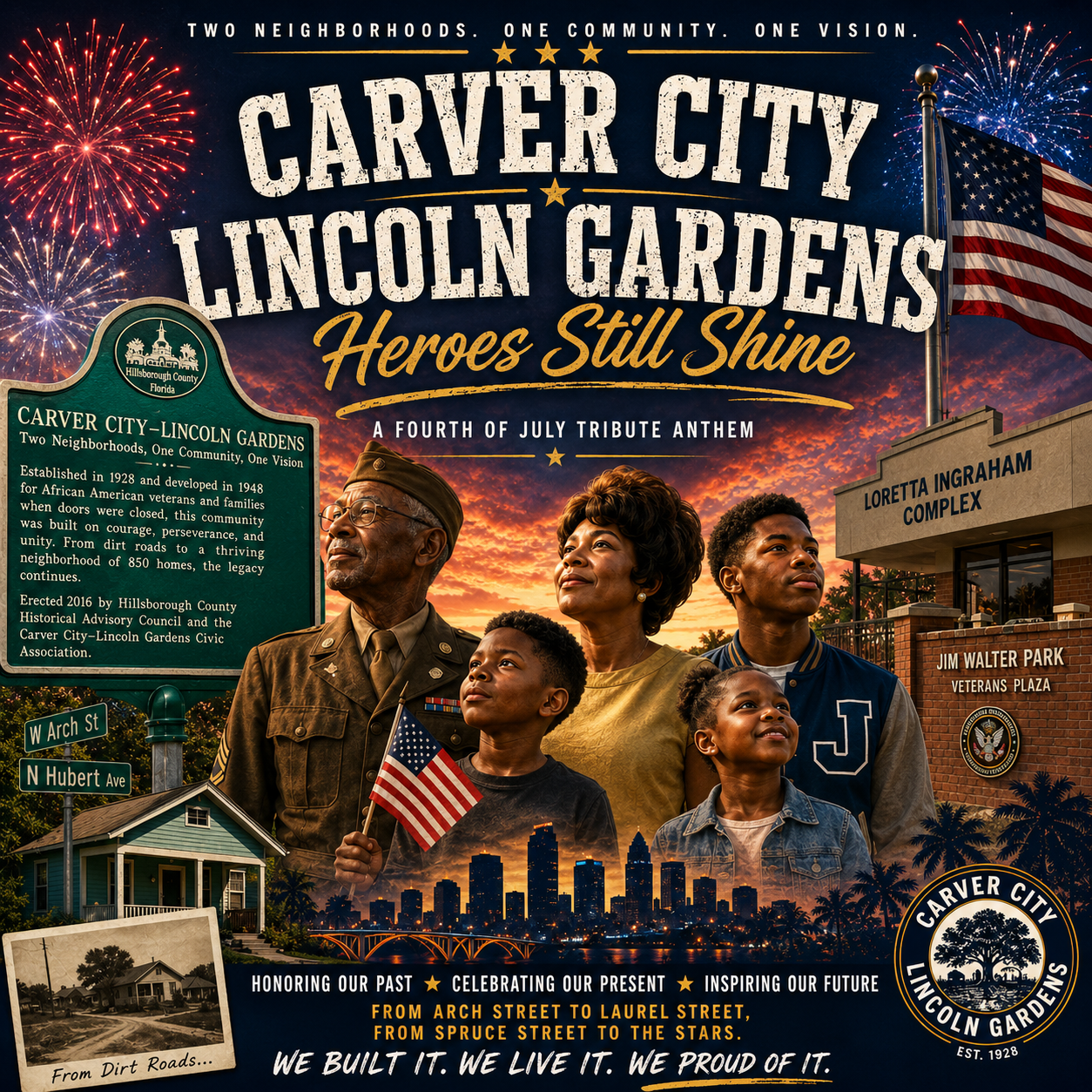
Carver City–Lincoln Gardens is more than a neighborhood in West Tampa. It is a story of determination, family, service, and people creating opportunity when the world did not make it easy.
This Fourth of July, we are honoring that legacy with a neighborhood song for Carver City–Lincoln Gardens—a celebration of the heroes, families, streets, parks, schools, and local places that make this community special. The message is simple: two neighborhoods, one community, one vision.
A Community Built on Courage
The roots of Carver City–Lincoln Gardens stretch back to 1928, when some of the first modern homes for African American families in the area were built on West Arch Street and West Laurel Street. At the time, the area was still largely open land, with homesteaders, farmers, fishermen, dirt roads, watering holes, and wildlife. But those early homes represented something bigger: a chance for families to establish roots, build stability, and create a future in Tampa.
After World War II, Black service members returned home after serving their country, only to face housing discrimination and barriers to using the benefits they had earned. Black veterans and their families were unable to access many of the housing opportunities available through the GI Bill, and there were not adequate accommodations for Black military families connected to MacDill Field. Instead of giving up, the community pushed forward.
In 1948, through the persistence of veterans, families, MacDill Field Base Housing, and the Veterans Administration, Lincoln Gardens was developed as one of the first planned Black subdivisions in the Carver City area. The first model homes were built on Spruce Street, creating a lasting symbol of resilience and homeownership. Carver City, the older and larger adjoining neighborhood, continued to grow as a place where Black families could build lives, raise children, and create a strong middle-class community. By 1983, Carver City and Lincoln Gardens officially came together through one civic association—turning two proud neighborhoods into one unified community.
The Streets Carry the Story
Every neighborhood has streets. But in Carver City–Lincoln Gardens, streets like West Arch Street, West Laurel Street, West Spruce Street, West Nassau Street, West Grace Street, North Hubert Avenue, North Grady Avenue, and Dale Mabry Highway carry history. They are the roads generations traveled to work, church, school, ballgames, family cookouts, neighborhood meetings, and celebrations.
They represent people who built their own opportunities, maintained their homes, watched out for one another, and passed pride from one generation to the next. Today, the neighborhood has grown into a diverse, multi-ethnic community of roughly 850 homes, while still holding tightly to the history that shaped it.
Honoring Loretta Ingraham and Community Leadership
A major part of that story is Loretta Ingraham, a respected civil rights leader, organizer, and neighborhood advocate. Loretta Ingraham helped found the Civic Action Association of Carver City/Lincoln Gardens and served as its first president. She worked to establish neighborhood crime-watch efforts and helped create opportunities for local children, including support for youth baseball and Little League programs.
Her name lives on at the Loretta Ingraham Complex on North Hubert Avenue, a place where children and families can gather for recreation, swimming, sports, and community connection. That is what real neighborhood leadership looks like: seeing what the community needs and helping make it happen.
Parks, Schools, and Places That Bring People Together
The community's pride can still be felt at Jim Walter Park, a place that honors the veterans and families whose persistence helped establish Lincoln Gardens. It is felt in the energy around the Loretta Ingraham Recreation Center and Pool, where kids play, neighbors connect, and memories are made. It is felt in the classrooms and hallways connected to Jefferson High School, where young people continue preparing for their own futures.
And it is felt throughout the surrounding Westshore area—from local dining and celebrations at places like Eddie V's and Fleming's Steakhouse to the everyday movement along Dale Mabry near Jerry Ulm Dodge. The neighborhood has deep historic roots, but it also remains connected to the life, business, and momentum of modern Tampa.
A Song for the Heroes Still Shining
The new Fourth of July song, "Carver City–Lincoln Gardens: Heroes Still Shine," is meant to bring all of that history to life. It honors the veterans who returned home and refused to let discrimination stop their dreams. It honors the families who bought homes, raised children, created community organizations, and turned open land into a neighborhood full of pride. It honors the leaders who fought for safety, recreation, and opportunity. And it honors every resident today who continues to make Carver City–Lincoln Gardens a place worth celebrating.
This is not only a song about fireworks, flags, and the Fourth of July. It is a song about freedom meaning something real. Freedom to build. Freedom to belong. Freedom to own a home. Freedom to create a legacy.
As the fireworks light up the Tampa sky this Independence Day, take a moment to remember the people who helped make this community what it is. Carver City–Lincoln Gardens: two neighborhoods, one community, one vision—and a legacy that still shines. 🇺🇸