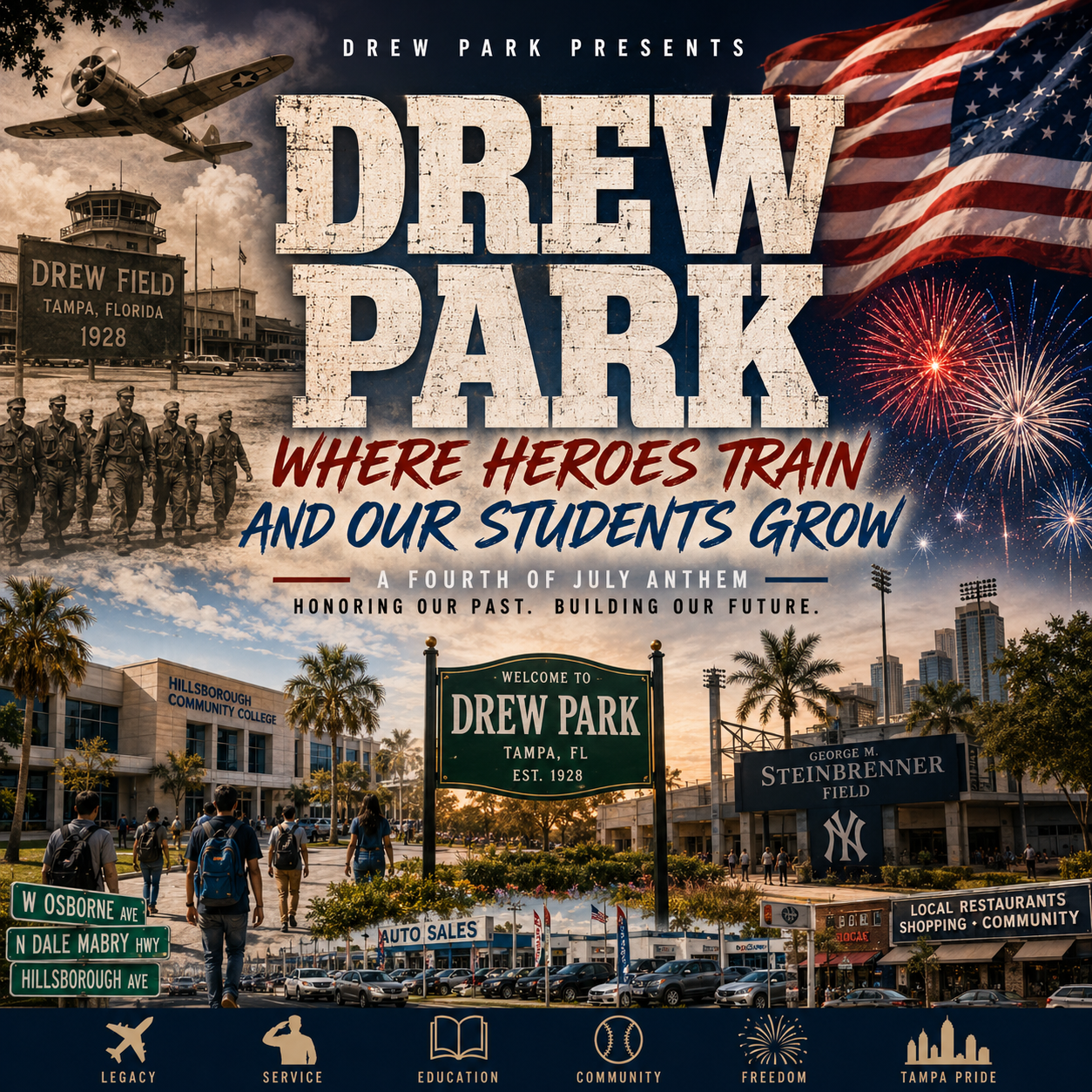
Every Tampa neighborhood has a story, but Drew Park's story is written across runways, classrooms, ballfields, businesses, and generations of people who helped move this city forward.
This Fourth of July, we are celebrating Drew Park with a neighborhood anthem called "Where Heroes Train and Students Grow." It is a tribute to the service members who trained at Drew Field, the families and workers who built a community around it, and the students today who are creating Tampa's next chapter.
From Open Land to Tampa's First Airport
Before it was known as Drew Park, this area was called Drew Field, named for cattleman, developer, and aviation supporter John Higley Drew. In 1928, Tampa opened its first municipal airport here on a grass airfield. What began as open land and early aviation dreams became an important part of Tampa's growth. By 1934, the city had purchased the property and added runways, hangars, lighting, and other improvements with support from federal public-works programs. Drew Field was more than an airport. It represented a city looking forward.
A Place Where Heroes Prepared
When World War II began, Drew Field took on an even bigger role. The federal government leased the property and transformed it into a major Army Air Corps base. The installation expanded across a large portion of what is now Drew Park, stretching from the Hillsborough Avenue area toward Columbus Drive and Dale Mabry Highway.
During the war, Drew Field became home to military training, air operations, barracks, hospitals, theaters, libraries, recreation halls, classrooms, and even a prisoner-of-war camp. More than 100,000 soldiers were stationed or trained there between 1940 and 1945. Combat crews prepared for service. Planes filled the sky. Families and workers supported the base from the ground. The weekly newspaper, Drew Field Echoes, helped keep the military community connected during a time when communication and morale mattered deeply.
That history is why the song's hook says: "Drew Park, where our heroes train, where our students grow through the sun and rain." The heroes came first, carrying the responsibility of defending their country. Their courage left a foundation that is still felt in the neighborhood today.
Dale Mabry: A Road Built for Connection
In 1943, Dale Mabry Highway was constructed to connect Drew Field with MacDill Field to the south. Today, Dale Mabry is one of Tampa's most traveled roads, but its role in Drew Park's history runs much deeper than traffic. It was built to move people, equipment, and military resources during wartime. It connected two major aviation and military centers that helped shape Tampa's identity. Every time we travel down Dale Mabry, pass Tampa Bay Boulevard, or head toward Hillsborough Avenue, we are moving through a piece of that history.
From Drew Field to Tampa International Airport
After World War II ended, Drew Field was deactivated as an Army Air Corps base. Parts of the land returned to civilian use, and the airport resumed commercial operations. National Airlines and Eastern Airlines began serving the area in the mid-1940s. In 1952, the municipal airport was renamed Tampa International Airport.
The old Drew Field legacy still rises into the sky every day. Every departure from Tampa International is connected to the early airfield, military training grounds, and aviation vision that began right here.
Where Students Grow
Drew Park is not only a neighborhood with military and aviation history. It is also a place of opportunity. Today, the area is home to the main campus of Hillsborough Community College, where students come to earn degrees, learn trades, build careers, and create new futures for themselves and their families. The same land where service members trained now helps students prepare for their own missions.
Along streets like W South Avenue, W Osborne Avenue, W Alva Street, W Crest Avenue, N Huber Avenue, N Hale Avenue, N Grady Avenue, and W Martin Luther King Jr. Boulevard, the neighborhood carries both its past and its future. Drew Park is a place where history does not stay in a museum. It lives in the streets, in the classrooms, in the small businesses, in the workers opening up each morning, and in the students walking toward what comes next.
Baseball, Big Events, and Tampa Pride
Drew Park is also home to George M. Steinbrenner Field, where generations of fans have gathered to watch baseball and make memories under the Florida sun. Nearby, Raymond James Stadium brings Tampa together for major games, concerts, and community celebrations. The area's energy is hard to miss: baseball cheers, football crowds, restaurant tables filling up, dealerships along Dale Mabry, local shops, light-industrial businesses, and people working hard every day.
Drew Park has always been a place in motion. Planes once took off from its fields. Soldiers trained for service. Students now prepare for careers. Fans gather for games. Businesses keep the neighborhood moving.
Celebrating Drew Park This Fourth of July
This Fourth of July, the fireworks mean something extra in Drew Park. They honor the military men and women who trained at Drew Field. They honor the workers who built Tampa's future. They honor the students at HCC who are working toward their goals. They honor the families who call this community home.
Drew Park is proof that a neighborhood can carry history while still building tomorrow. So when the sky lights up red, white, and blue, remember the words: Drew Park, where our heroes train. Where our students grow. From the runway lights to the fireworks high, we lift our voices on the Fourth of July.
Happy Fourth of July, Drew Park. Your history matters. Your people matter. And your future is still taking flight. 🇺🇸