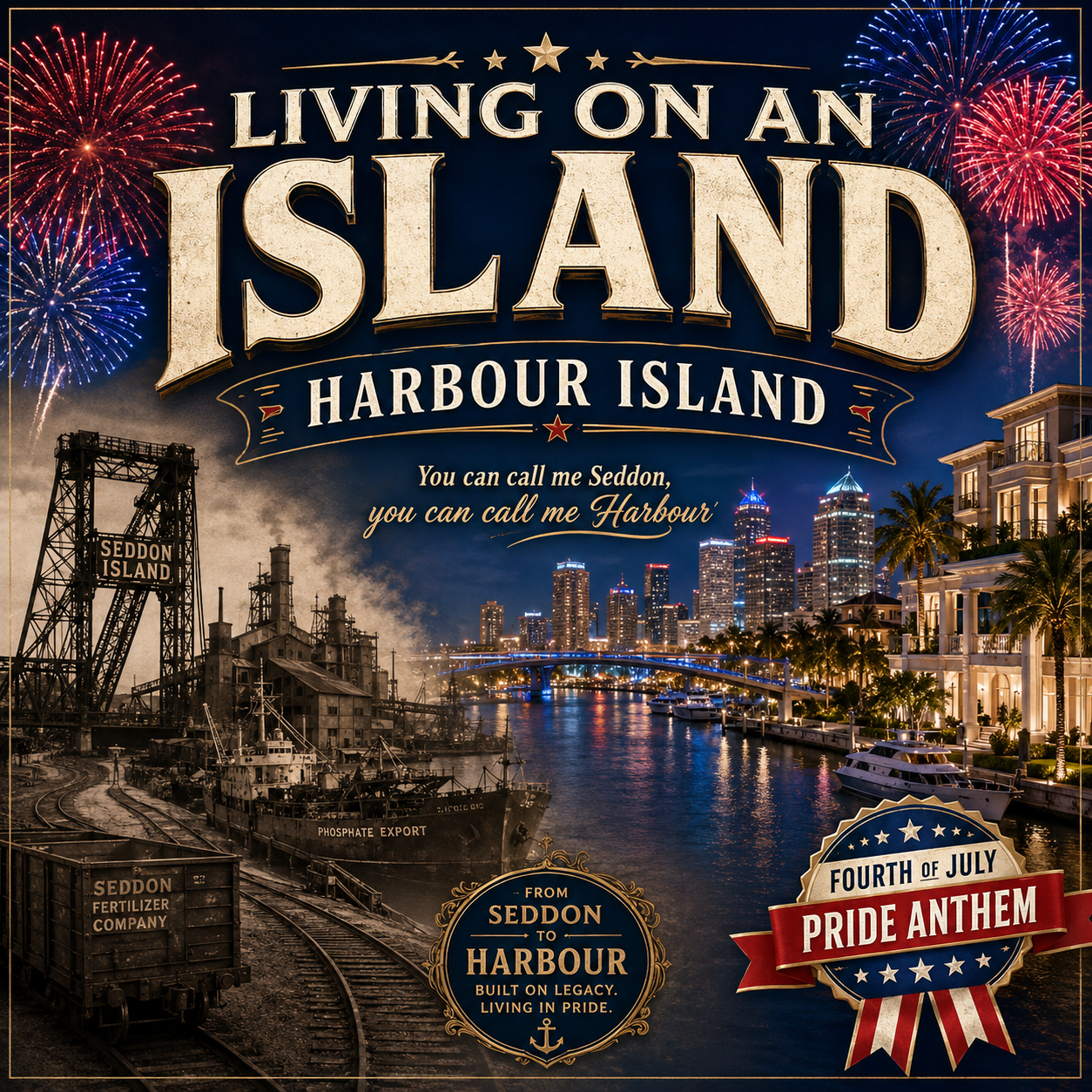
Harbour Island is one of the most recognizable places near downtown Tampa today. Its waterfront homes, bridges, marina views, and proximity to the city make it feel like a world of its own.
But Harbour Island was not always Harbour Island. Before the homes, offices, restaurants, and skyline views, this 177-acre property was a working industrial island known as Seddon Island. It was shaped by dredging, railroads, phosphate shipping, and the growth of Tampa as a port city.
That history inspired the Fourth of July neighborhood anthem, "Living on an Island." Its hook captures the island's identity perfectly: "You can call me Seddon, you can call me Harbour, it doesn't matter 'cause I'm living on an island." The song is about pride in both chapters of the island's story: the industrial past that helped Tampa grow and the waterfront community that exists there today.
Before Seddon Island: Mudflats, Mangroves, and Grassy Islands
Harbour Island did not exist in its modern form before the early 1900s. The area near the mouth of the Hillsborough River was once made up of low-lying islands, mudflats, mangroves, and shallow water. These areas were known by several names over time, including Depot Key, Rabbit Island, Big Grassy Island, and Little Grassy Island.
Little Grassy Island sat near the route that would become the shipping channel into downtown Tampa. It was small, low, and vulnerable to high tides. Big Grassy Island remained nearby and would later become part of Davis Islands after extensive fill work in the 1920s. As Tampa expanded, its leaders, railroad companies, shipping interests, and the federal government all recognized that the city needed better port access to compete as a Gulf Coast commercial center.
The Port Creates an Island
In the early 1900s, the U.S. Army Corps of Engineers and railroad interests began dredging deeper shipping channels through Hillsborough Bay. The dredging created enormous amounts of sand and fill material. Rather than discard it, engineers used it to build out land near and on Little Grassy Island. This work created a larger man-made island that could serve Tampa's growing port.
The island became known as Seddon Island, named for W. L. Seddon, chief engineer for the Seaboard Air Line Railroad. Seddon helped oversee plans to improve Tampa's port and establish rail access to the new island. A steel rolling-lift bridge was installed in 1908, connecting the island to downtown and allowing railroad traffic and vehicles to reach the docks. The bridge, warehouses, railroad spurs, wharves, and phosphate facilities turned Seddon Island into an active industrial center.
Tampa's Phosphate Era
For decades, Seddon Island was a major phosphate-loading terminal and railroad yard. Phosphate was one of Florida's most important industries, and Tampa became a key shipping point because of its access to rail lines and deepwater routes. Freight trains carried phosphate to the island, where it was loaded onto cargo ships headed for markets around the world.
From the early 1900s through the late 1960s, Seddon Island was a place of industrial movement. Ships came and went. Tugboats worked the channels. Warehouses and elevators stood near the water. Railcars crossed the bridge. Workers kept the port moving. The island was not built for luxury. It was built for work. And that work played a major role in Tampa becoming a serious port city.
A Different Kind of Island Childhood
Even during the industrial years, Seddon Island was more than just tracks, docks, and phosphate elevators. A small number of people lived on the island, including the Schaibly family in the late 1960s and early 1970s. Their father worked as superintendent of the phosphate-loading terminal, and the family lived near the southern end of the island.
For the children, the island became an unforgettable backyard. They fished, boated, hunted, explored docks, watched cargo ships, built forts, and even traveled by small boat to Davis Islands to catch the school bus. They grew up surrounded by water, rail activity, tugboats, warehouses, and open space—an unusual childhood within sight of downtown Tampa. Their stories remind us that Harbour Island's history is not only about land development. It is also about the people who lived, worked, and found adventure there before the modern neighborhood existed.
From Seddon Island to Harbour Island
By the 1970s, the industrial role of Seddon Island was fading. In 1979, Beneficial Corporation purchased the 177-acre island from Seaboard Coast Line for $2.9 million. The company saw potential in a place that many people still viewed as a worn industrial property filled with outdated infrastructure. The vision was ambitious: transform the island into a new mixed-use waterfront community with homes, offices, shops, restaurants, hotels, and public spaces.
Groundbreaking for redevelopment took place in 1983. Bridges were built to improve access from downtown. The old railroad lift bridge was dismantled in 1984. New development took shape around the Harbour Island Hotel, office space, the Marketplace, residences, and waterfront amenities. In 1985, Harbour Island officially opened. Former President Gerald Ford participated in the opening celebration by driving a golf ball from the mainland across Garrison Channel toward the island. It was a symbolic moment: a former industrial shipping yard had become one of Tampa's newest urban destinations.
The Harbour Island People Mover
One of the most memorable chapters of Harbour Island's redevelopment was the Harbour Island People Mover. Opened in 1985, the elevated automated tram connected Harbour Island with downtown Tampa and the Fort Brooke Parking Garage. The system crossed Garrison Channel on an elevated concrete guideway and was designed to make it easier for visitors, workers, and shoppers to move between the island and downtown.
The people mover was a bold idea for its time. It represented Tampa's interest in bringing rail-style transit back to the urban core after the earlier streetcar system had ended decades before. The system never attracted enough riders to remain financially sustainable, however. It stopped operating in 1999, and the guideway was later dismantled. Even so, the People Mover remains part of Harbour Island's story. It was an early experiment in the kind of urban connection Tampa would later pursue through the TECO Line Streetcar and other downtown transportation improvements.
Harbour Island Today
Today, Harbour Island is known for waterfront living, bridges, marinas, offices, apartments, townhomes, single-family homes, and close proximity to downtown Tampa. Its original redevelopment vision changed over time. The retail Marketplace struggled and was later converted to office space. The island's mix of uses evolved. But the larger transformation succeeded: a place once defined by phosphate elevators and rail yards became a modern waterfront neighborhood with a strong identity of its own.
Harbour Island is a reminder that Tampa has always been a city shaped by water, industry, transportation, and reinvention. This Independence Day, when the fireworks reflect across Garrison Channel, remember that the view is more than beautiful. It is historic. From Little Grassy Island to Seddon Island, from phosphate ships to waterfront homes, from an elevated people mover to the city skyline, Harbour Island carries more than one name. It carries a century of Tampa history.
You can call it Seddon. You can call it Harbour. Either way, it is still an island with a story worth celebrating. 🇺🇸