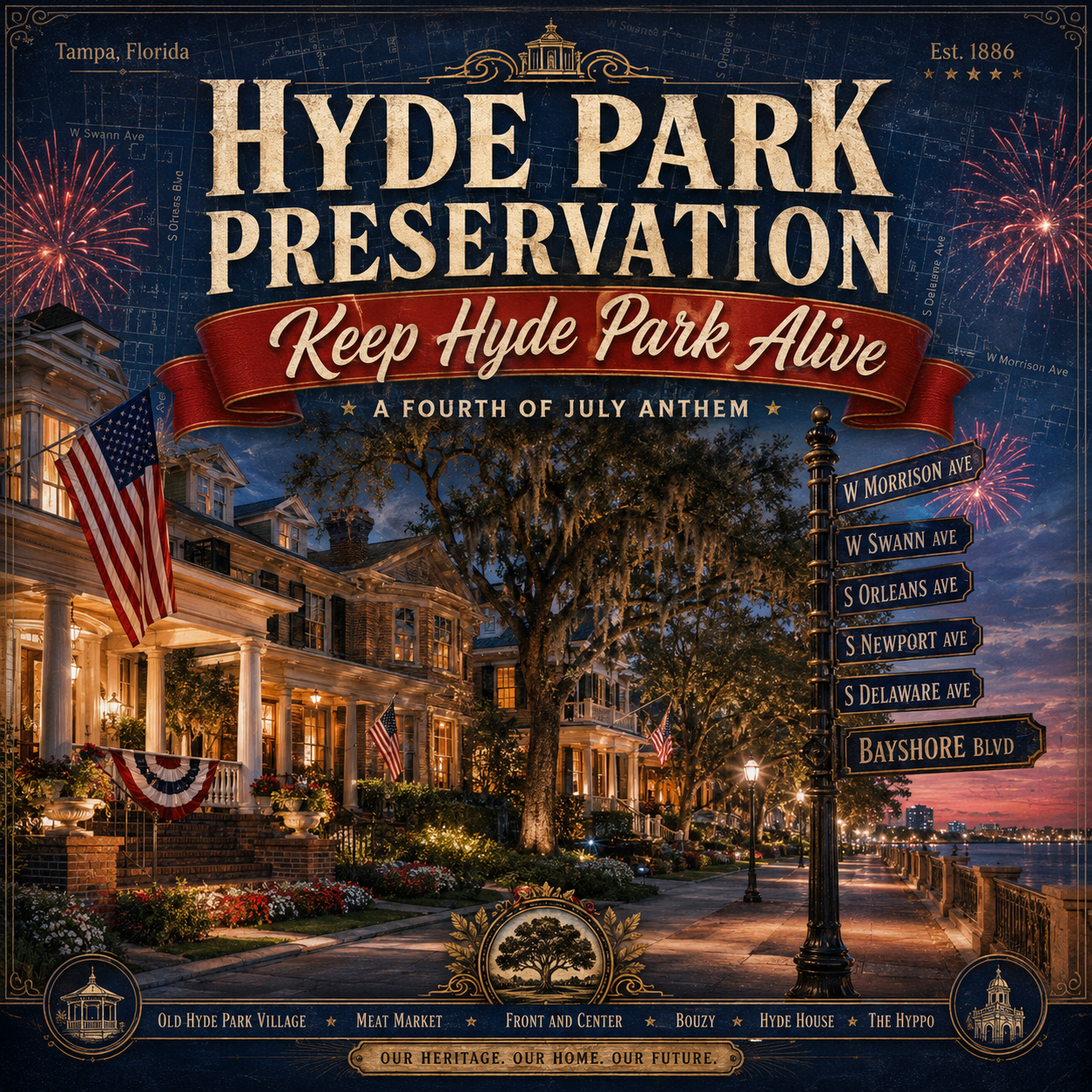
Hyde Park Preservation is not just a neighborhood association or a section of one of Tampa's best-known communities. It is the reason so much of Tampa's architectural history is still standing today.
The tree-lined streets between the Hillsborough River and Bayshore Boulevard hold more than beautiful homes. They hold the story of Tampa's earliest west-of-the-river suburb, its railroad-era expansion, its citrus and cattle fortunes, its difficult years of decline, and the residents who refused to let a historic neighborhood disappear. That is the spirit behind the Fourth of July anthem, "Keep Hyde Park Alive."
A Neighborhood Born from Tampa's Growth
The beginnings of Hyde Park reach back to the 1880s, when Tampa was still a smaller city shaped by shipping, agriculture, railroads, and the river. In 1886, O. H. Platt purchased approximately 20 acres from the Robert Jackson farm on the south side of the Hillsborough River. Platt had come from Hyde Park, Illinois, and gave his new Tampa subdivision the same name. At the time, the land was largely agricultural, with citrus groves and open property stretching south from the river.
The location became more valuable when Henry B. Plant transformed Tampa's future. Plant's railroad arrived in Tampa in the 1880s, opening stronger connections to the rest of Florida and the country. He also built a bridge over the Hillsborough River, giving residents and visitors a direct link between downtown and the growing residential land to the south and west. In 1891, Plant's Tampa Bay Hotel opened along the riverfront. Today, that landmark is home to the University of Tampa, but in its day it was a grand statement that Tampa was becoming an important destination. The bridge, railroad, hotel, and river access created the conditions for Hyde Park to grow into one of the city's most desirable places to live.
The Families Whose Names Still Mark the Map
Hyde Park was shaped by early Tampa families who saw opportunity in the land and invested in its future. James Watrous, William Morrison, and Alfred Swann were among the citrus growers, cattle ranchers, business leaders, and developers who cleared land and built homes in the area. Their names remain embedded in the neighborhood's geography. Watrous Avenue, Morrison Avenue, Swann Avenue, and Platt Street are not just street signs. They are reminders of the people who helped build Tampa during an era of rapid change.
By 1910, Hyde Park had become one of the most desirable residential areas in the city. The neighborhood offered shaded streets, large homes, proximity to downtown, and access to the river and bay. It attracted merchants, professionals, citrus growers, shipping interests, and families seeking a more refined residential setting outside the commercial core.
Architecture That Tells Tampa's Story
Hyde Park's historic streets hold one of the finest collections of early residential architecture in Florida. The neighborhood is known for its rich mix of Georgian and Colonial Revival homes, Queen Anne residences, Prairie-style influences, half-timbered houses, Mediterranean Revival designs, Craftsman bungalows, and early Florida homes from the 1920s and 1930s.
The Morrison Grove area, in particular, became known for some of the city's most distinctive homes. Every architectural style reflects a different chapter in Tampa's growth: the Victorian era, the early 20th-century boom years, the influence of national design trends, and the Florida adaptation of porches, shade, high ceilings, and tropical landscaping. These homes were never meant to be museum pieces. They were built for families. Their porches hosted conversations. Their dining rooms held holidays. Their sidewalks carried children to school. Their yards grew gardens beneath the live oaks. That lived-in history is what makes Hyde Park special.
The Hard Years—and the Decision to Fight Back
Hyde Park's story is not one of uninterrupted prosperity. The Great Depression slowed construction and changed the neighborhood's trajectory. Some of the larger homes were converted into boarding houses as families adapted to economic hardship. After World War II, newer suburban neighborhoods attracted returning veterans and young families, and Hyde Park began to lose some of its earlier status.
Then came one of the most difficult chapters: the construction of the Crosstown Expressway, now known as the Selmon Expressway. During the 1970s, the project cut through the area and resulted in the loss of historic mansions and parts of the neighborhood fabric. For many communities, that might have been the end of the story. For Hyde Park, it became the beginning of a preservation movement.
Concerned neighbors created the Old Hyde Park Garden Club and Hyde Park Preservation, Inc. in 1974. Their mission was not simply to save individual houses. They wanted to protect the character of the neighborhood: the homes, the tree canopy, the sidewalks, the architecture, and the sense of community that had made Hyde Park meaningful for nearly a century. Their work helped shift the conversation from demolition to restoration.
The 1980s Revival
The revival of Hyde Park gained momentum in the 1980s. In 1985, the City of Tampa designated Hyde Park as a local historic district. That designation created protections for historic homes and established design guidelines for renovations and new construction. It recognized that preservation is not about freezing a neighborhood in time. It is about allowing it to grow in a way that respects the story already written there.
That same year, Hyde Park Village opened, bringing new shopping, restaurants, and community activity to the area. The Village became a modern gathering place while the surrounding historic homes and shaded streets gave it a setting unlike any other retail district in Tampa. New residents arrived. Longtime residents stayed and continued restoring homes. Families invested in the neighborhood, and Hyde Park once again became one of Tampa's most vibrant places to live.
Hyde Park Preservation Today
Today, Hyde Park Preservation remains a close-knit residential community in the middle of a fast-changing city. The neighborhood is close to downtown Tampa, SoHo, the riverfront, and Bayshore Boulevard, yet it maintains a quieter atmosphere beneath its oak canopy. Residents can walk or bike to restaurants, entertainment, parks, schools, shops, waterfront views, and neighborhood landmarks while still coming home to historic streets and front porches.
The community's annual Old Hyde Park Home Tour is one of the ways this history is shared. The tour opens the doors to distinctive homes and lets visitors experience the architecture, restoration work, gardens, and craftsmanship that make Hyde Park unique. Proceeds support preservation and beautification efforts, including projects that help protect the neighborhood's historic character and tree canopy. The tour also shows that preservation is not only about looking backward. It is about inviting people in, teaching the story, supporting the neighborhood, and making sure the next generation understands why these homes matter.
A Community of History and Everyday Life
Hyde Park Preservation is not separated from the life of the city. It is part of it. Residents are close to Front and Center, Meat Market, Hyde House, Bouzy, Bonobos, ZIMMERMANN, Public Studio, Coastal Cowgirls Collective, and The Hyppo Hyde Park. These businesses bring current energy to the area while the historic streets and preserved homes keep the neighborhood rooted.
That balance is the heart of Hyde Park Preservation. It is a place where a person can walk beneath century-old oaks, pass homes built in the early 1900s, enjoy a meal or an ice cream nearby, and see how old Tampa and modern Tampa exist side by side.
"Keep Hyde Park Alive"
The Fourth of July song "Keep Hyde Park Alive" is a celebration of everyone who has helped protect this neighborhood. It honors O. H. Platt's original vision in 1886. It honors Henry B. Plant, the bridge, the railroad, and the Tampa Bay Hotel. It honors James Watrous, William Morrison, and Alfred Swann, whose names still shape the map. It honors the families who lived through hard times and kept their homes standing. It honors the preservationists and volunteers who organized in 1974. It honors the residents who helped achieve historic district designation in 1985. And it honors the families, businesses, schools, and neighbors carrying the story forward today.
On the Fourth of July, Hyde Park Preservation does more than celebrate with flags and fireworks. It celebrates the fact that its history is still here. From the Hillsborough River to Bayshore Boulevard. From Morrison Avenue to Swann Avenue. From the first citrus groves to the historic homes beneath the oaks. Hyde Park Preservation keeps Tampa's past alive—and gives its future something worth protecting. 🇺🇸