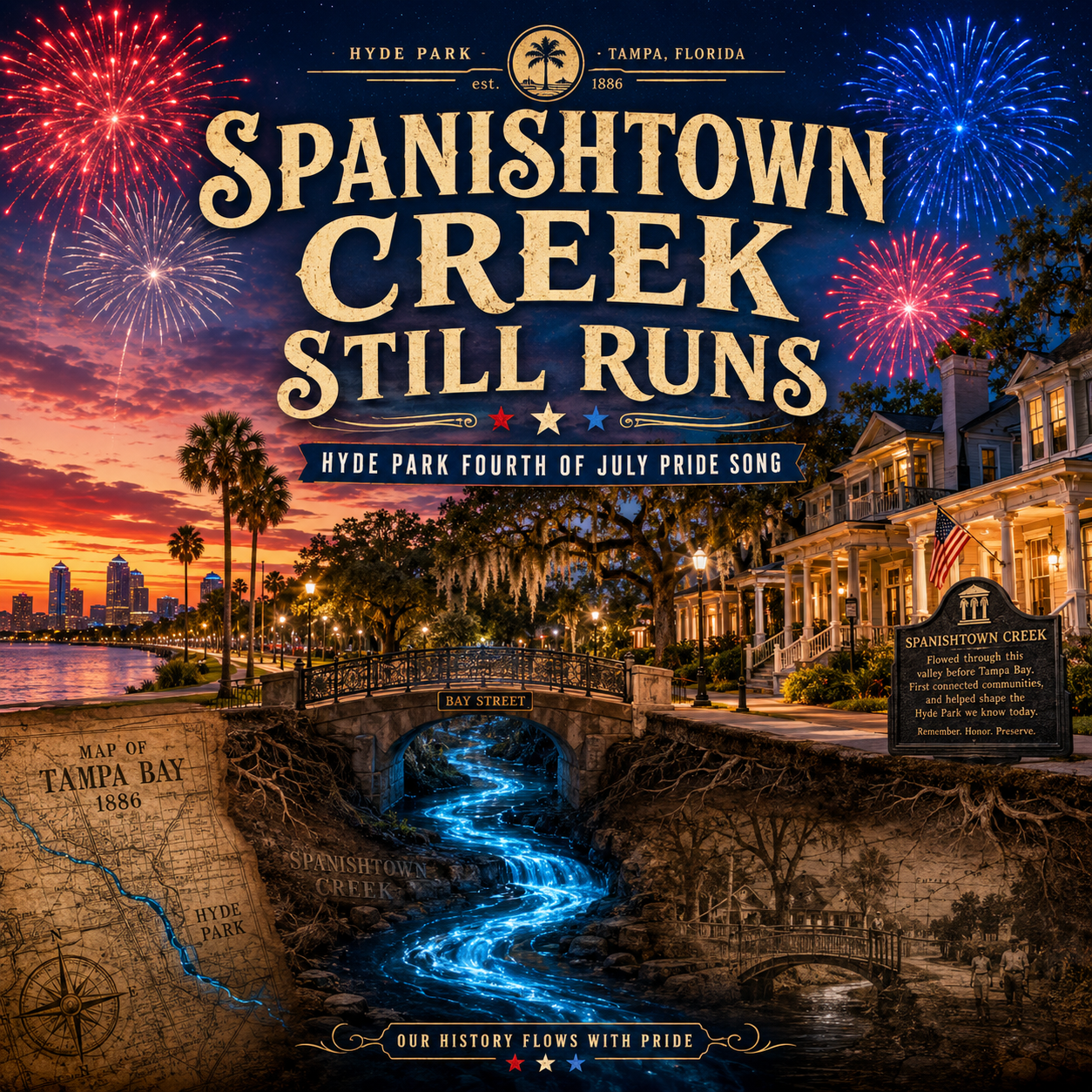
Before Bayshore Boulevard became one of Tampa's most recognizable roads, before Hyde Park became a neighborhood of porches, parks, schools, and tree-lined streets, there was a creek.
Spanishtown Creek once moved through what is now Hyde Park and Hyde Park North, flowing toward Hillsborough Bay through an area that helped shape some of Tampa's earliest history. Today, much of the creek is hidden beneath streets, stormwater systems, culverts, and development. But its story is still there—under Bay Street, near Magnolia Avenue, beneath parts of the neighborhood, and in the memories preserved by historians, maps, markers, and longtime Tampa families.
This Fourth of July, we are celebrating that deep history with a new neighborhood pride song: "Spanishtown Creek Still Runs." The song honors the people, places, and events that came long before the modern Tampa we see today. It is about remembering that Hyde Park's story did not begin with new homes, restaurants, or roadways. It began with water, fishing, homesteads, storms, and families determined to rebuild.
Before Fort Brooke, There Was Spanishtown Creek
Spanishtown Creek is believed to have been home to one of the earliest non-Native settlements in the Tampa area. Historical accounts describe Cuban fishermen living near the creek around 1783, decades before Fort Brooke was established. At that time, Tampa was not yet the city it would become. The area around the creek was shaped by shoreline, fishing, palmettos, open land, and small settlements. The creek offered access to the bay and supported the people who lived and worked near it.
Long before roads crossed the peninsula, Spanishtown Creek was part of everyday life. It was a place where people fished, traveled by water, built simple homes, and lived close to the natural landscape. The creek was not just a feature on a map. It was part of the foundation of Tampa.
The Jackson Family and Early Hyde Park
In the 1820s and 1830s, the area around what is now Hyde Park became home to families who supplied goods and produce to nearby Fort Brooke. Robert Jackson and his wife, Nancy, became part of that story. They lived near the mouth of Spanishtown Creek and built a home close to the bayfront. The Jackson family worked the land, grew vegetables, and helped support the growing military outpost at Fort Brooke.
At the time, Tampa was still a small frontier community. The area was rural, with farms, gardens, small homes, and water routes connecting people to the bay. The Jackson family's life near Spanishtown Creek showed how important the waterway was to early Tampa. It was close to the bay, close to the fort, and close to the land families depended on for food and survival.
The Great Gale of 1848
One of the most dramatic chapters in the area's history came on September 25, 1848, when a powerful hurricane struck Tampa Bay. The storm, sometimes called the Great Gale of 1848, brought destructive winds, flooding, and storm surge. Nearly every building along the water was damaged or destroyed. Fort Brooke was flooded, and much of Tampa's waterfront suffered major loss.
For the Jackson family, the storm was devastating. Their home near Spanishtown Creek was swept from its foundation by the rising water and heavy debris. Their crops were destroyed by saltwater. The family lost almost everything. But they survived. Like many early Tampa residents, they rebuilt. Their story became part of the larger story of Tampa itself: a community repeatedly shaped by storms, setbacks, and the determination to begin again.
From Creekside Homesteads to Hyde Park Streets
For many years, the area around Spanishtown Creek remained farmland, homesteads, and open land. That began to change in the late 1880s after Henry Plant expanded his railroad system and built the Tampa Bay Hotel. Tampa grew quickly, and new neighborhoods began to take shape south of the hotel. Areas around Hyde Park Avenue and Plant Avenue started to develop, and new plats created streets and lots where open land had once been.
The Packwood Subdivision, platted in 1892, still showed the route of Spanishtown Creek as it curved through the area. At that time, the creek remained part of the physical landscape, crossing beneath or alongside streets that would later become familiar parts of Hyde Park. Old photographs from the early 1900s show a bridge being built over the creek near Bay Street. Other historic images show the creek traveling through culverts beneath Magnolia Avenue, south of De Leon Street. For a time, the creek still had a visible presence in the neighborhood.
Bayshore Boulevard and the Hidden Creek
As Tampa continued to grow, Spanishtown Creek was gradually altered, filled in, redirected, and incorporated into the city's stormwater drainage system. By the 1930s, major public works projects changed the edge of the bay. The WPA helped create the Bayshore Boulevard many people recognize today, with its concrete roadway and iconic seawall.
The creek became less visible, but it did not disappear. Much of its route still exists underground through drainage infrastructure. There are signs of its former path near the newer Davis Islands bridge and the Bayshore on-ramp, where drainage outlets reveal that water is still moving beneath the city. A historical marker at Bay Street helps preserve the memory of the creek and reminds people that Hyde Park's history is literally beneath their feet.
A Fourth of July Song for What Still Flows
The new song, "Spanishtown Creek Still Runs," is a Fourth of July anthem about pride, memory, and honoring the people who came before us. Its central message is simple: Spanishtown Creek still runs, even when you cannot see—under Hyde Park, under Bay Street, under the roots of history.
On the Fourth of July, Hyde Park and Spanishtown Creek celebrate more than fireworks and summer nights. They celebrate survival, change, and generations of people who built homes and community along this historic part of Tampa. From the Cuban fishermen who lived near the creek in the late 1700s, to early farming families, to Robert and Nancy Jackson, to the railroad era, the WPA, and the families living here today, Spanishtown Creek remains part of the neighborhood's identity.
You may not see the creek from the sidewalk anymore. But it still runs. And so does the history. 🇺🇸