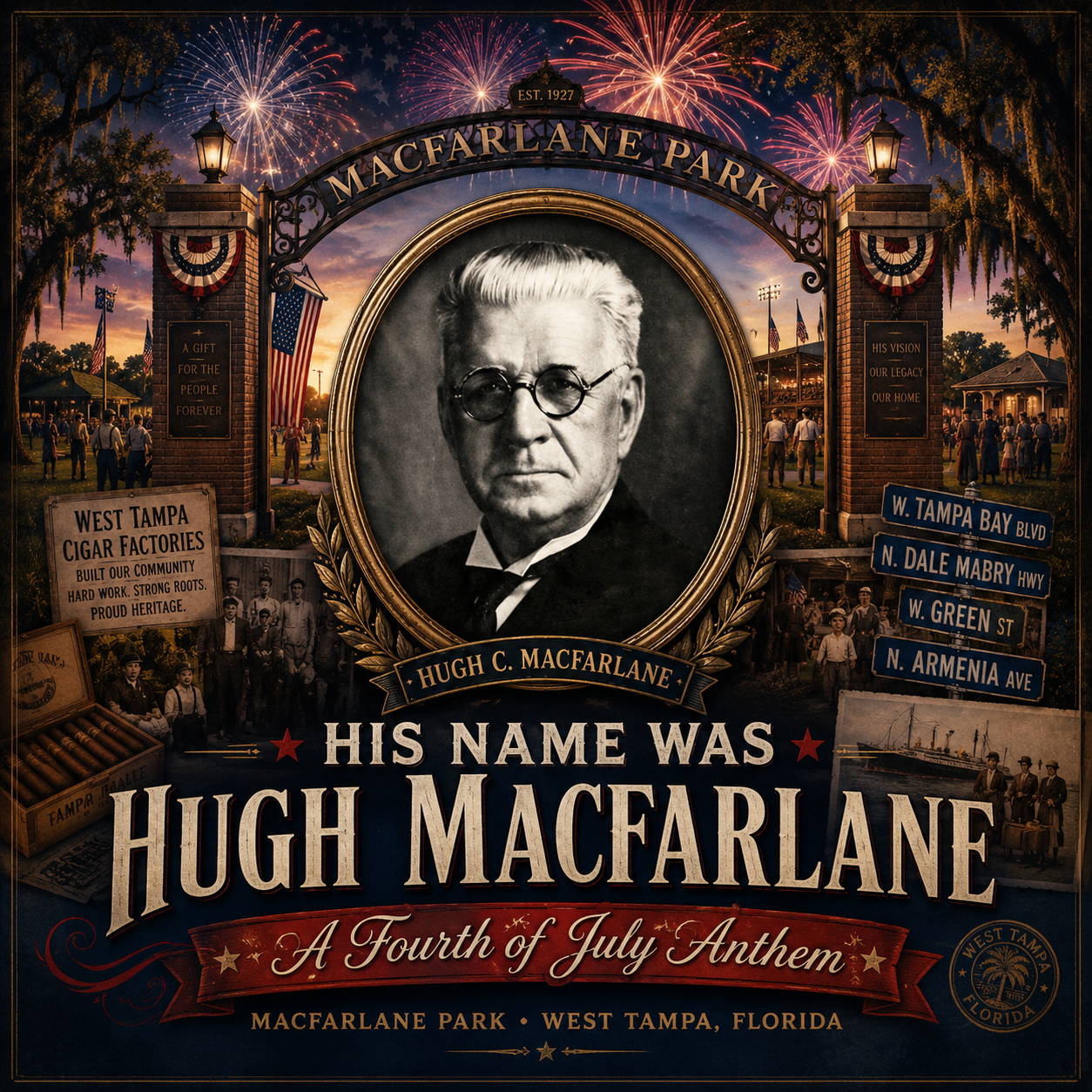
Macfarlane Park is more than a neighborhood green space in West Tampa. It is a reminder of how one person's vision helped create an entire community.
The park, the surrounding neighborhood, the nearby schools, and the historic streets of West Tampa all connect back to Hugh C. Macfarlane, a Scottish immigrant whose influence helped turn undeveloped land into a thriving cigar city. That legacy is the inspiration behind the Fourth of July anthem, "His Name Was Hugh Macfarlane."
A Scottish Immigrant with a Tampa Vision
Hugh C. Macfarlane arrived in Tampa during a period when the city was beginning to grow beyond its early port-town roots. In 1886, he purchased land in what would become West Tampa. At the time, the area was largely undeveloped. Macfarlane saw potential in the land and began building a planned community around industry, housing, transportation, and opportunity. His vision was not simply to sell lots. He wanted to create a place where people could work, raise families, and build a future.
By 1892, Macfarlane's cigar factory began production. The cigar industry was already becoming one of Tampa's defining economic forces, and West Tampa quickly became a major center of cigar manufacturing. Factories created jobs, and jobs brought families from around the world. Cuban, Spanish, Sicilian, Scottish, Irish, German, and other immigrant families made West Tampa their home. They brought their languages, traditions, food, faith, craftsmanship, and work ethic with them. Together, they gave West Tampa its distinctive character.
The Birth of the City of West Tampa
The success of the cigar industry and the arrival of new residents led to the incorporation of the City of West Tampa on May 18, 1895. West Tampa grew quickly. It became a place of factories, schools, shops, homes, clubs, churches, and community institutions. In only a few years, it developed into one of the most important communities in Hillsborough County.
Macfarlane and other local leaders invested in the infrastructure needed to support that growth. A steel bridge over the Hillsborough River and a streetcar line helped connect West Tampa to the rest of Tampa. That connection brought workers, commerce, and new opportunities while allowing West Tampa to maintain its own strong identity. For thirty years, West Tampa stood as its own municipality. In 1925, it was annexed into the City of Tampa, but the pride of West Tampa never disappeared. You can still see it in the old factory buildings, community institutions, historic markers, and the families who have called this area home for generations.
The Gift That Became Macfarlane Park
One of Hugh Macfarlane's most lasting gifts came in 1908. He donated approximately 40 acres of drained, partially wooded land to the city as a free public recreational space for cigar factory workers and their families. The land became Macfarlane Park. That was a major act of community investment.
At a time when factory work could be demanding and long hours were common, the park gave working families a place to breathe. It was a place for children to run, neighbors to gather, families to picnic, and generations to create memories. Today, Macfarlane Park remains the green heart of the neighborhood. Its ball fields, playgrounds, tennis and racquetball courts, picnic areas, and open space continue the purpose Macfarlane intended more than a century ago. The iconic park archway, built in the mid-1930s, welcomes visitors into a place that is both historic and alive with everyday community activity.
A Neighborhood Built Around Community
Macfarlane Park sits roughly between West Tampa Bay Boulevard to the north, North Dale Mabry Highway to the west, West Green Street to the south, and North Armenia Avenue to the east. Those boundaries frame a neighborhood where history is never far away.
North Lincoln Avenue holds the West Tampa Centennial Marker, which tells the story of Hugh Macfarlane, the founding of West Tampa, the cigar industry, and the immigrant communities that helped build the city. Nearby historic sites and markers recall landmarks such as the old Cuesta-Rey cigar factory, Centro Español de West Tampa, Martí-Colón Cemetery, and the early growth of West Tampa's public institutions. The bricks at the base of the West Tampa Centennial Marker were salvaged from the former Cuesta-Rey Cigar Factory, a physical reminder that even after buildings are gone, their stories can remain part of the neighborhood.
Schools, Seniors, and the Next Generation
Macfarlane Park is also defined by the people who use it every day. Macfarlane Park School for International Studies serves students and families in the neighborhood, while West Tampa Elementary continues the long tradition of education in this part of the city. These schools help create the next chapter of West Tampa's story.
The David M. Barksdale Senior Citizen Center provides a gathering place for older residents and keeps the park connected to every generation. From children on playgrounds to seniors meeting at the center, Macfarlane Park remains a place where people belong. That is what makes it more than a park. It is a community anchor.
"His Name Was Hugh Macfarlane"
The Fourth of July song "His Name Was Hugh Macfarlane" was written as a salute to the person whose vision helped shape this neighborhood. The song honors Hugh Macfarlane's arrival from Scotland, his work building West Tampa, the rise of the cigar industry, the immigrant families who made the community thrive, and his decision to donate land for a public park. It also celebrates the streets, schools, ball fields, playgrounds, historic markers, and gathering places that keep the community strong today.
On the Fourth of July, Macfarlane Park has a special reason to celebrate. It is not only a place for fireworks, flags, cookouts, and family fun. It is a place built on hard work. It is a place built by immigrants. It is a place built around community. And it is a place made stronger because Hugh Macfarlane believed that people deserved somewhere to gather, play, and grow.
So raise a glass. Give a salute. His name was Hugh Macfarlane. And his legacy still lives in West Tampa. 🇺🇸