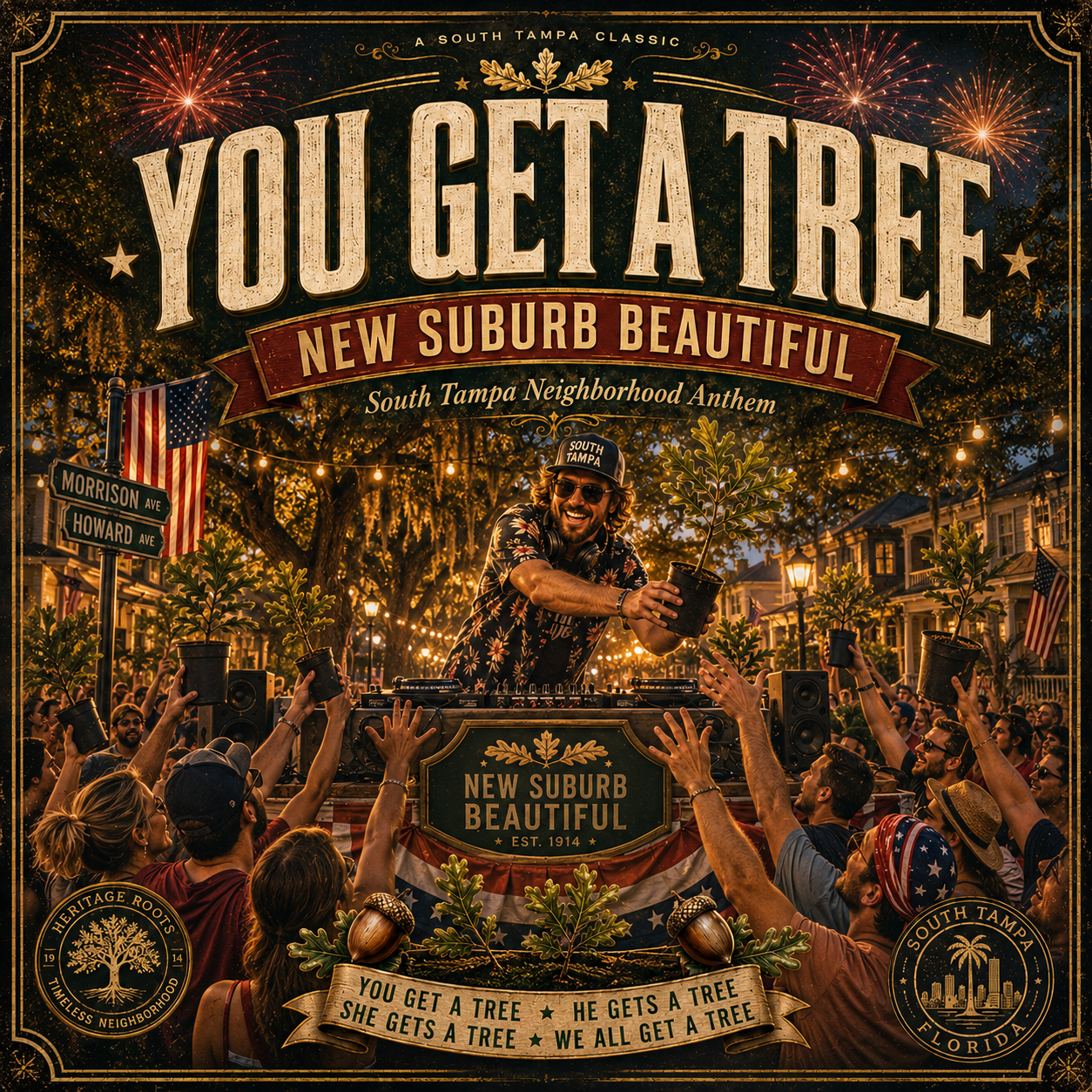
New Suburb Beautiful is not just one of Tampa's most recognizable neighborhood names. It is one of the city's original planned residential communities, shaped by the optimism of the 1920s, preserved by generations of families, and defined today by its walkable streets, towering oaks, neighborhood relationships, and unmistakable South Tampa character.
Tucked within the Hyde Park area, New Suburb Beautiful sits between Morrison Avenue, MacDill Avenue, Prospect Road, Howard Avenue, and the Selmon Expressway. It is a compact neighborhood, but it carries a history that reaches back more than 100 years. From Sunset Drive and Watrous Avenue to Jetton, Georgia, Marti, Moody, and Prospect, the streets of New Suburb Beautiful tell a story of Tampa's growth from a smaller Gulf Coast city into the place people know today.
A New Vision for South Tampa
New Suburb Beautiful began in 1923, during a period when Tampa was expanding quickly and new neighborhoods were beginning to shape the city beyond its earlier downtown and Hyde Park boundaries. The original subdivision was platted with 211 lots. It included land along Sunset Drive and Prospect Road between Howard and MacDill Avenue—then known as Lisbon Avenue—as well as part of Watrous Avenue. The neighborhood was developed by Allen J. Simms, a prominent Tampa real estate entrepreneur who had a reputation for selling ambitious ideas as much as he sold land.
Simms and his team were not simply marketing a collection of lots. They were presenting a lifestyle. A 1924 advertisement called New Suburb Beautiful the "subdivision supreme," highlighting its wide sidewalks, paved streets, planted parkways, and homes built by skilled craftsmen. The message was clear: this would be a neighborhood designed with beauty, order, and long-term value in mind.
The original plan included residential standards that were intended to create a cohesive community. Homes were to be single-family residences, set back from the street, and built with a minimum value of $6,000—an important investment for the era. The vision was for a neighborhood where the streets felt open, the homes felt permanent, and the surroundings added to the quality of daily life.
The Meaning Behind the Streets
New Suburb Beautiful's street names are part of what makes the neighborhood feel so rooted in Tampa history. Watrous Avenue honors the Watrous family, whose land holdings once included parts of what would become Hyde Park and New Suburb Beautiful. Sunset Drive and Prospect Road reflect the naming style of early twentieth-century subdivision planning, when developers used words that suggested promise, beauty, and a relaxed suburban life.
The neighborhood's east-to-west streets—Howard Avenue, Moody Avenue, Georgia Avenue, Marti Street, and MacDill Avenue—create a familiar rhythm for residents who have spent years walking, biking, driving, and raising families here. North to south, Morrison Avenue, Jetton Avenue, Watrous Avenue, Sunset Drive, and Prospect Road form the backbone of the neighborhood. These are not just street names on a map. They are the routes to school, the paths to a neighbor's home, the streets where children learn to ride bikes, and the places families return to after generations away.
The Oak Trees That Changed the Neighborhood
Few features define New Suburb Beautiful more than its heritage oak canopy. That canopy did not simply happen by accident. In 1974, local resident Lillian Wharton took on a project that would leave a lasting mark on the neighborhood. Through the Amaryllis Garden Circle, Wharton pushed for the planting of heritage live oaks throughout the community.
Her approach became part of neighborhood legend. She reportedly went door to door—often in high heels—asking residents a direct question: "Do you want a tree?" The answer, over time, became a neighborhood-wide yes.
Beginning in September 1974, city crews planted the first five of what would become approximately 200 heritage oaks brought in from Texas. Today, those trees are part of the identity of New Suburb Beautiful. They shade sidewalks, frame homes, cool the streets, and give the community the sense of established beauty that residents and visitors immediately recognize. The trees are also a reminder that neighborhoods are shaped by people who care enough to take action. One resident's determination became a lasting legacy for generations who may never know her personally but still walk beneath the canopy she helped create.
A Place Where Generations Return
New Suburb Beautiful has long been known as a neighborhood where people put down roots. Families move in, raise children, stay connected, and sometimes return years later. Homes are passed through families. New residents are welcomed into an already-established community. Longtime neighbors recognize one another at local events, walking the sidewalks, or stopping at nearby businesses along Howard Avenue and Dale Mabry.
That sense of continuity is rare in a growing city. The neighborhood contains a blend of historic residences and newer homes, but its character remains consistent because the people who live there continue to care about the streets, the trees, the sidewalks, and the relationships that make it feel like home. With just over 400 homes, New Suburb Beautiful remains small enough for a neighborhood identity to feel real rather than symbolic.
Walkability, Local Businesses, and Everyday Connection
One of the biggest advantages of New Suburb Beautiful is that it combines a peaceful residential setting with access to some of South Tampa's most popular local destinations. Howard Avenue and Dale Mabry Highway are both close by, giving residents easy access to restaurants, coffee shops, retail, services, and neighborhood gathering places. Hyde Park Village, Bayshore Boulevard, and the broader SoHo area are all part of the lifestyle that surrounds the community.
But New Suburb Beautiful's relationship with local businesses goes beyond convenience. The neighborhood has embraced a community-first approach through the NSB Perks Card, resident events, happy hours, and partnerships with small businesses. That connection helps create a neighborhood culture where supporting local businesses is part of supporting one another. It is the kind of place where a quick stop for coffee can turn into a conversation with a neighbor, and a local event can become a tradition families look forward to year after year.
A Neighborhood That Still Feels Like Home
New Suburb Beautiful was created during Tampa's early twentieth-century growth, but it has stayed relevant because it never lost the qualities that made it desirable in the first place. The wide sidewalks still invite people outside. The oak trees still create a beautiful canopy. The streets still feel intimate and walkable. The homes continue to reflect a mix of Tampa history and modern family life.
Most importantly, the neighborhood has held onto its sense of community. From the original 1923 plat to the Heritage Live Oak Project of the 1970s to the families and neighbors who continue caring for the area today, New Suburb Beautiful has always been shaped by people who believed a neighborhood could be more than a place to live. It could be a place to belong.
That is why New Suburb Beautiful remains one of Tampa's most loved historic neighborhoods: not simply because of where it is, but because of what it has always been—a community built with intention, shaded by history, and carried forward by generations. 🇺🇸