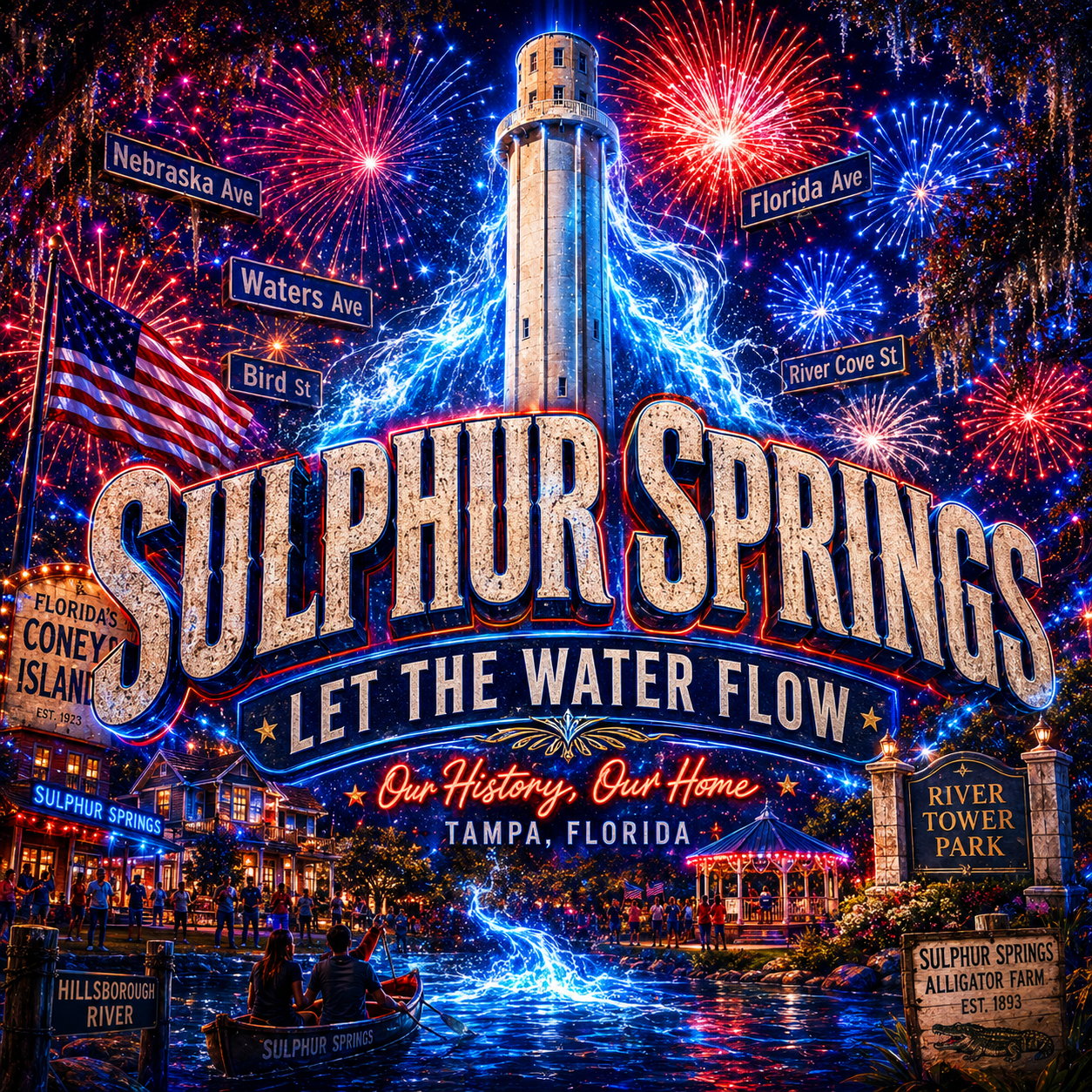
Six miles north of Downtown Tampa, along the Hillsborough River, there is a neighborhood with a story unlike any other in the city. Sulphur Springs was built around water, imagination, hard work, and a community spirit that has endured through every era of change.
Long before its famous white water tower became a Tampa landmark, Sulphur Springs was known for the mineral-rich spring that bubbled from the earth near the river. People believed the water carried healing qualities. Visitors came by foot, horse and buggy, bicycle, river launch, and eventually streetcar to experience the cool waters and the natural beauty surrounding them. Today, Sulphur Springs remains a neighborhood where history is visible on the streets, in the river, in the parks, and especially in the towering landmark that rises above River Tower Park.
From Natural Spring to Tampa Destination
The story of Sulphur Springs stretches back to the late 1800s, when the area was still largely rural land north of Tampa. The Hillsborough River created a natural setting unlike the growing city to the south, and the spring quickly became the center of attention. John Henry Krause, one of Tampa's early German-American pioneers and businessmen, owned much of the land around the spring during the 1880s. In 1889, the growing importance of the area led city commissioners to authorize a bridge across the Hillsborough River, giving more people access to the community.
By the turn of the century, Dr. John H. Mills had transformed the land around the spring into a small resort destination. He developed bathhouses, walking paths, a dock, a restaurant, a fishpond, and a swimming pool fed by the bubbling mineral waters. At a time when Tampa was still expanding outward from its historic core, Sulphur Springs offered residents and visitors a place to cool off, gather, and enjoy the river. The trip itself became part of the experience. Early visitors traveled along narrow roads and over the old iron bridge near what is now Van Dyke Place. Soon, boats carried people up the Hillsborough River. By 1907, the streetcar arrived, connecting Sulphur Springs to Tampa, Ybor City, West Tampa, and the rest of a rapidly growing city. The sound of the trolley and the sight of families arriving at the springs marked the beginning of a new era.
Florida's Coney Island
In 1904, entrepreneur Josiah Richardson purchased the Sulphur Springs property and began dreaming much bigger. What had been a peaceful swimming destination grew into one of Tampa's most memorable amusement districts. Richardson developed attractions that brought crowds from across the region. The park featured swimming pools, a dance pavilion, restaurants, a zoo-like alligator farm, water attractions, and eventually a towering slide that became one of the area's best-known thrills. At its height, Sulphur Springs was called "Florida's Coney Island."
People came to dance, swim, laugh, eat, shop, and enjoy the Florida sunshine. The neighborhood became a destination for working families, tourists, and Tampa residents looking for a day away from the routines of city life. The annual Fourth of July celebrations were especially lively. Brass bands played throughout the day, couples danced in the pavilion, swimming pools filled with families, and the community came together along the river for music, food, and celebration. Sulphur Springs was not just a place to visit. It was a place where memories were made.
The Hotel, Arcade, and Tampa's First Indoor Mall
Richardson's vision reached another level in the 1920s with the construction of the Sulphur Springs Hotel and Arcade near Nebraska Avenue and Bird Street. The hotel and arcade were built between 1926 and 1927 and occupied an entire city block. The structure included shops, hotel accommodations, and a grand arcade that reflected the resort-style architecture popular during Florida's land boom. It is widely remembered as Florida's first indoor shopping center.
For Sulphur Springs, the Arcade represented more than a new building. It represented confidence in the future. It showed that the neighborhood was not on the edge of Tampa's story. It was helping write it. The growth of the district also brought the construction of the Sulphur Springs Water Tower in 1927. Rising approximately 225 feet above the neighborhood, the white tower was built to provide water pressure for the hotel, apartments, arcade, and surrounding development. Built in only eight days, the tower became an instant landmark. Nearly a century later, it still rises above the river and remains one of the most recognizable sights in all of Tampa.
A Neighborhood That Endured
Sulphur Springs has never been defined only by its prosperous years. Its history also includes hardship, change, and the determination of residents who continued to call the neighborhood home. In September 1933, a catastrophic flood caused major destruction throughout the area. The collapse of the Tampa Electric dam and the flooding that followed damaged the Arcade and devastated Richardson's ambitious resort plans. The entertainment district that once drew enormous crowds could not fully recover.
Over the decades, segregation, disinvestment, highway construction, and changing development patterns reshaped the neighborhood. These chapters are part of the real story of Sulphur Springs and part of why its remaining landmarks matter so much. The community was annexed into the City of Tampa in 1953, but its identity remained distinct. The Water Tower continued supplying artesian well water to local properties until 1971. In the 1950s, the Tower Drive-In Theatre opened near the river, creating another generation of memories beneath the glow of neon lights and the shadow of the water tower. For decades, residents and community advocates fought to protect the tower from redevelopment plans that could have erased the landmark from Tampa's skyline. Their efforts mattered. The tower survived, was restored, and continues to stand as a symbol of neighborhood strength.
River Tower Park and the Next Chapter
Today, River Tower Park gives residents and visitors a place to experience the setting that made Sulphur Springs special in the first place. The Hillsborough River still moves past the neighborhood. The white tower still catches the sunlight. Families still gather in the park. Community events still bring people together. The Sulphur Springs Museum and History Center at 1101 East River Cove Street helps preserve and share the stories that deserve to be remembered: the spring, the streetcars, the alligators, the dance pavilion, the Arcade, the tower, the drive-in, and the people who made this neighborhood what it is.
Sulphur Springs is more than an old tourist attraction. It is more than a landmark on the Tampa skyline. It is a neighborhood built from generations of families, workers, dreamers, entrepreneurs, and advocates who refused to let its story disappear. From Waters Avenue to the Hillsborough River, from Florida Avenue to Nebraska Avenue, Sulphur Springs carries a history that is bold, colorful, complicated, and deeply Tampa. The water still flows. The tower still stands. And Sulphur Springs is still here. 🇺🇸