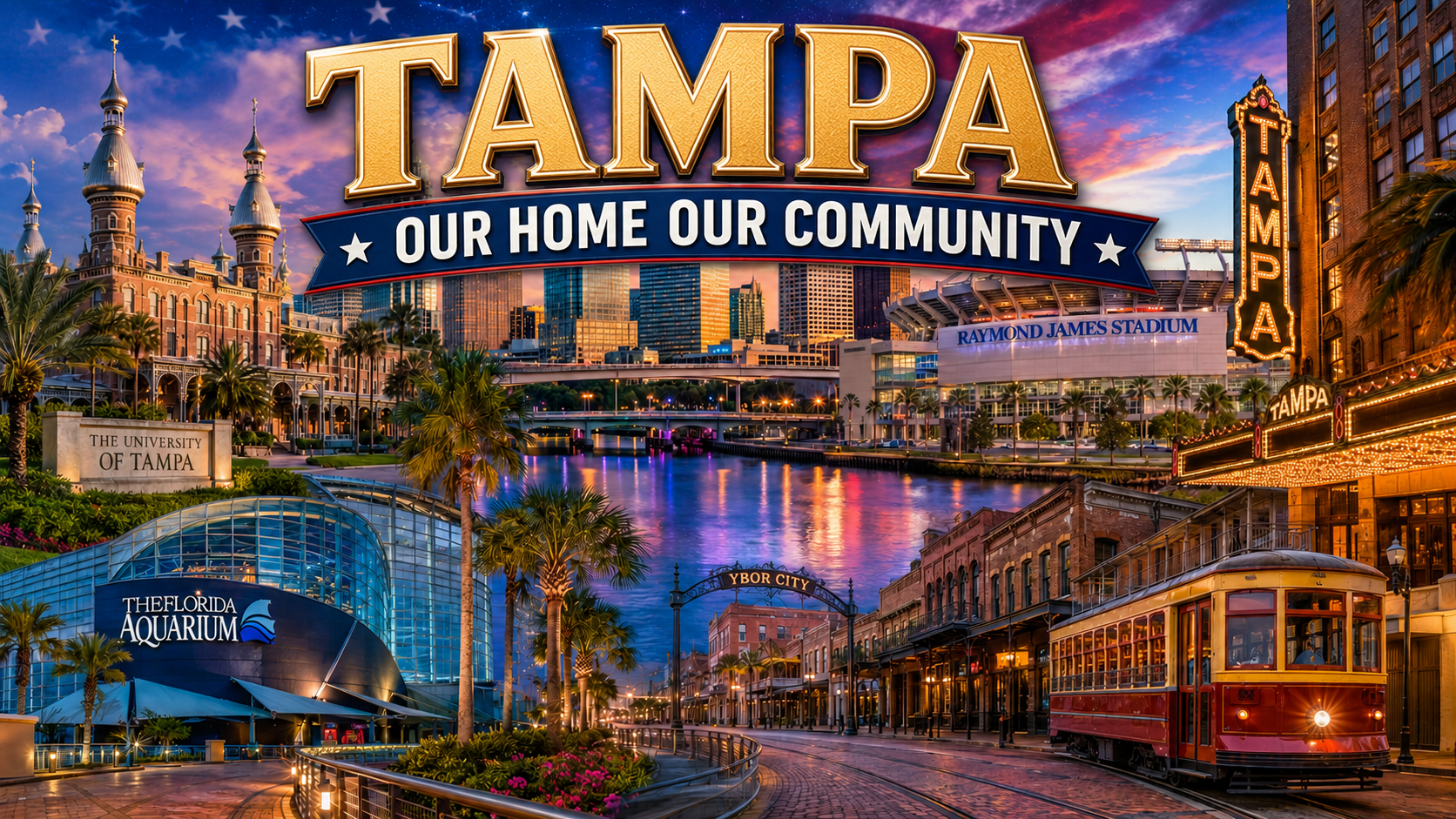
This is the one that ties it all together — a single anthem for the whole city, drawing on the history, the streets, and the people of every Tampa Bay neighborhood.
Tampa is not just a city on the bay. It is a city built by generations of people who arrived from different places, spoke different languages, carried different traditions, and decided to build a future together. That is why Tampa is so special.
Long before there were downtown towers, the Riverwalk, streetcars, cigar factories, or stadiums, Indigenous peoples lived along the shores of Tampa Bay for thousands of years. Communities connected to the Tocobaga, Pohoy, and other Native peoples depended on the bay, its rivers, and its natural resources. Their history is the first chapter of Tampa's story.
In 1821, the United States took control of Florida from Spain. Soon after, Fort Brooke was established at the mouth of the Hillsborough River in January 1824, near what is now Downtown Tampa. At that time, Tampa was a small and isolated frontier settlement, but its location on Tampa Bay would eventually help turn it into one of Florida's most important cities. Florida became a state on March 3, 1845. Just a few years later, Tampa was officially incorporated as the Village of Tampa on January 18, 1849. It was still a small community, but the foundation was being laid for something much bigger.
The Transformation of the 1880s
The real transformation came during the 1880s. In 1883, phosphate was discovered southeast of Tampa, creating new business and shipping opportunities. That same year, Henry B. Plant's railroad reached Tampa, connecting the growing town to the rest of the country. The railroad changed everything. It made it easier to move people, products, tobacco, and opportunity in and out of Tampa.
Then, in 1885, Vicente Martinez Ybor brought his cigar manufacturing operation from Key West to Tampa. In 1886, Ybor City's factories rolled their first cigars. Workers and families arrived from Cuba, Spain, Italy, and other parts of the world to build a community around the cigar industry. Those workers did more than roll cigars. They built homes, opened restaurants and shops, started families, created mutual-aid societies, built churches, organized clubs, and gave Tampa a culture unlike anywhere else in Florida.
By 1900, more than 10,000 immigrants had moved into the Ybor City area, while West Tampa became another powerful cigar community. Cuban, Spanish, Italian, Afro-Cuban, Jewish, Scottish, Irish, German, Black, Caribbean, and other working families all helped shape Tampa into the city we know today. That is why Tampa earned the name Cigar City. During the early 1900s, Tampa's cigar factories were the backbone of the local economy. In 1929, at the peak of the industry, more than 500 million cigars were hand-rolled in Tampa. That is not just a business statistic, it represents generations of working people whose hands, sacrifice, talent, and determination helped build this city.
Every Neighborhood Adds Its Voice
Tampa has always been a place where people come to build something. You can see that spirit in Ybor City and Historic East Ybor, where the cigar industry changed Tampa forever. You can see it in West Tampa and West River, where workers, families, and immigrants helped create proud communities along the river. You can see it in East Tampa, Jackson Heights, Live Oaks Square, and other historically Black neighborhoods whose residents built leadership, culture, faith communities, businesses, and lasting strength through difficult times.
You can see Tampa's story in Sulphur Springs, where the springs and the famous water tower became part of the city's identity. You can see it in Lowry Park Central, where families have made memories for generations along the Hillsborough River. You can see it in Palmetto Beach, where waterfront workers, shrimping families, and neighbors near McKay Bay created a community with deep roots. You can see it in North Hyde Park, where old cigar-factory buildings stand near new homes, restaurants, and businesses. You can see it in University Square, where students, families, newcomers, and people from around the world bring fresh energy to Tampa every year. You can see it in Tampa Palms, Carver City, Bon Air, Drew Park, Channel District, Downtown, and every neighborhood that adds its own voice to the city.
Many Cultures Standing Together
Tampa is not one culture. Tampa is many cultures standing together. It is Spanish spoken at one table and English spoken at another. It is Cuban bread, Italian food, soul food, Caribbean flavors, family recipes, local restaurants, and new businesses opening their doors. It is church bells, music in the streets, fireworks over the bay, front-porch conversations, neighborhood cookouts, and families cheering for the same city. It is old Tampa and new Tampa. It is the person whose family has been here for five generations and the person who arrived last year with a dream. Both are part of Tampa's future.
As we celebrate the Fourth of July, we should celebrate more than fireworks, flags, and parades. We should celebrate the people who made Tampa possible: the Indigenous communities who came first, the workers who built the cigar industry, the Black families who strengthened neighborhoods and created opportunity, the immigrants who arrived with courage, the small-business owners who take chances, the students who bring new ideas, and the neighbors who keep showing up for each other.
Tampa is awesome because it has never stopped growing, but at its best, it never forgets who built it. From the streets of Ybor to the riverbanks of West Tampa, from the historic neighborhoods of East Tampa to the lights of Downtown, this city is connected by more than roads, bridges, and buildings. It is connected by people. Tampa is a melting pot of history, culture, music, flavor, hard work, pride, and possibility. And every neighborhood has a song worth singing. Tampa is not just where we live. Tampa is what we build together. 🇺🇸
Is your neighborhood missing?
This project is growing one community at a time. If you don't see your Tampa Bay neighborhood yet, send me a message and I'll add it.
ignacio@ignaciotorano.com