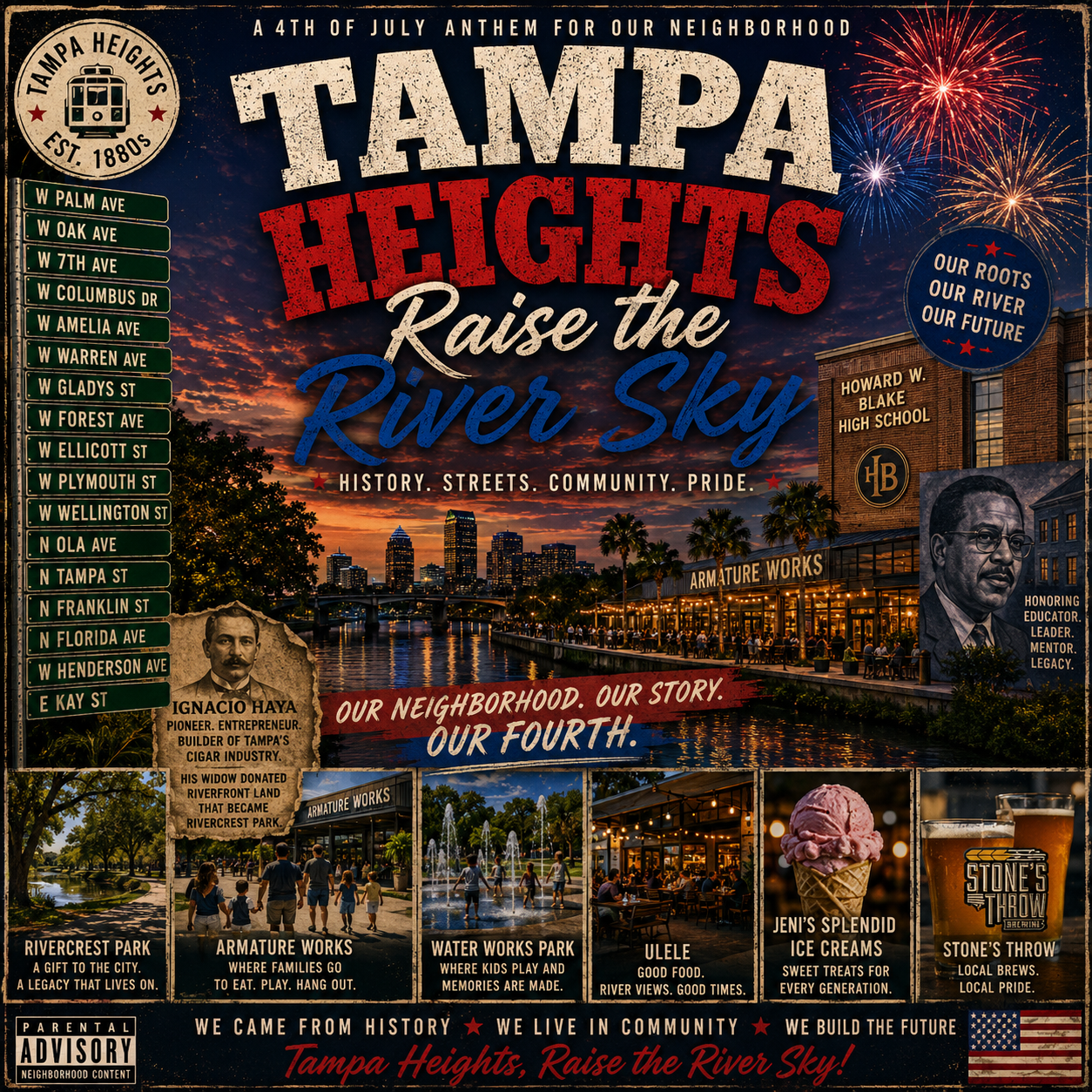
Tampa Heights has always been a neighborhood where Tampa's past and future meet. From its early days as one of the city's first prominent residential suburbs to the riverfront energy of today, Tampa Heights has remained a place built around history, family, creativity, education, and community pride.
This Fourth of July, the neighborhood gets its own anthem: "Tampa Heights, Raise the River Sky." It is a celebration of the people who built the Heights, the streets that hold its stories, the schools and parks that serve local families, and the river that continues to connect the neighborhood to the heart of Tampa.
One of Tampa's First Residential Suburbs
Tampa Heights began taking shape in the 1880s, when Thomas Puch Kennedy Jr. moved north of downtown to higher ground that he called "the Heights." That simple name stuck. At a time when Tampa was expanding quickly, the neighborhood became a desirable place for families looking for more space, fresh air, and a little distance from the busy downtown core. The economic growth of the mid-1880s helped bring new homes, larger properties, and successful residents to the area.
During the yellow fever outbreak of 1887, even more people were drawn to Tampa Heights because the higher elevation and distance from downtown were seen as healthier for families. The neighborhood became a place where residents could build homes surrounded by trees, gardens, porches, and open space. Among the notable early residents were Judge Joseph Robles, William Benton Henderson, and Wallace F. Stovall, one of the founders of the Tampa Tribune. Their presence reflected the importance Tampa Heights held in the growth of the city.
Streetcars, Bridges, and a Connected Community
Tampa Heights grew not only because of its higher ground, but because it was connected. The Tampa Street Railway Company trolley system helped residents travel between the neighborhood, downtown, and nearby communities. Streetcar access made Tampa Heights one of the city's early neighborhoods where residents could enjoy a more residential setting without being far from work, shopping, and the energy of the growing city.
The Fortune Street Bridge also helped tie the area to downtown Tampa and the surrounding riverfront. Today, you can still feel that connection in the neighborhood's street grid and its proximity to downtown, the Hillsborough River, Ybor City, and the growing north side of Tampa.
Streets That Carry the Tampa Heights Story
Tampa Heights is full of streets that connect old homes, new development, schools, parks, local gathering places, and the riverfront. West Palm Avenue, West Oak Avenue, West Seventh Avenue, West Columbus Drive, West Amelia Avenue, West Warren Avenue, West Gladys Street, West Forest Avenue, West Ellicott Street, West Plymouth Street, and West Wellington Street all reflect the neighborhood's mix of historic blocks and evolving city life.
Along North Ola Avenue, North Tampa Street, North Franklin Street, North Florida Avenue, West Henderson Avenue, and East Kay Street, Tampa Heights feels connected to both its past and its future. Walk or drive through the area and you will see historic homes, mature trees, river views, community spaces, and new places emerging alongside long-standing neighborhood character.
Howard W. Blake High School and a Legacy of Education
Howard W. Blake High School is one of the neighborhood's most important institutions. The school is named for Howard Wesley Blake, a respected African-American educator and community leader who devoted his life to improving educational and vocational opportunities for Black youth in Tampa. He was also known for emphasizing character, teamwork, respect, and leadership.
Today, Blake High School is a visual and performing arts magnet school, giving students opportunities to develop their gifts through music, dance, theater, visual art, and other creative fields. That spirit fits Tampa Heights well. This is a neighborhood where history, talent, hard work, and imagination continue to come together.
The Riverfront: Where Families Gather
The Hillsborough River is one of the defining features of Tampa Heights. It gives the neighborhood a natural center of gravity and creates space for people to walk, play, relax, and connect. At Water Works Park, families gather around splash areas, open lawn, river views, and community events. It is the kind of place where kids run free, parents catch up, and visitors quickly understand why the neighborhood feels so alive.
Armature Works has also become a major gathering place for Tampa Heights families. It is a place where parents, kids, grandparents, friends, and neighbors can meet by the river, share a meal, enjoy a drink, listen to music, or spend an afternoon together. It represents the modern side of Tampa Heights: active, social, welcoming, and connected to the river. Nearby spots such as Ulele, Rocca, Stone's Throw, and Jen's Splendid Ice Creams add to the neighborhood's energy and give people more reasons to gather close to home.
A Fourth of July Anthem for Tampa Heights
"Tampa Heights, Raise the River Sky" was created as a Fourth of July crowd anthem for everyone who has helped shape the neighborhood. It honors the early residents who helped build Tampa's first prominent suburb. It celebrates the trolley lines, historic homes, downtown connections, street names, Howard W. Blake High School, riverfront parks, and the places where families gather today.
Most of all, it celebrates the people who make Tampa Heights feel like home. When the fireworks begin this Fourth of July, raise your hands and sing it loud: Tampa Heights, raise the river sky. From Palm Avenue to Oak Avenue, this neighborhood is home to you. From the first suburb to the future bright, Tampa Heights lights up the night. 🇺🇸