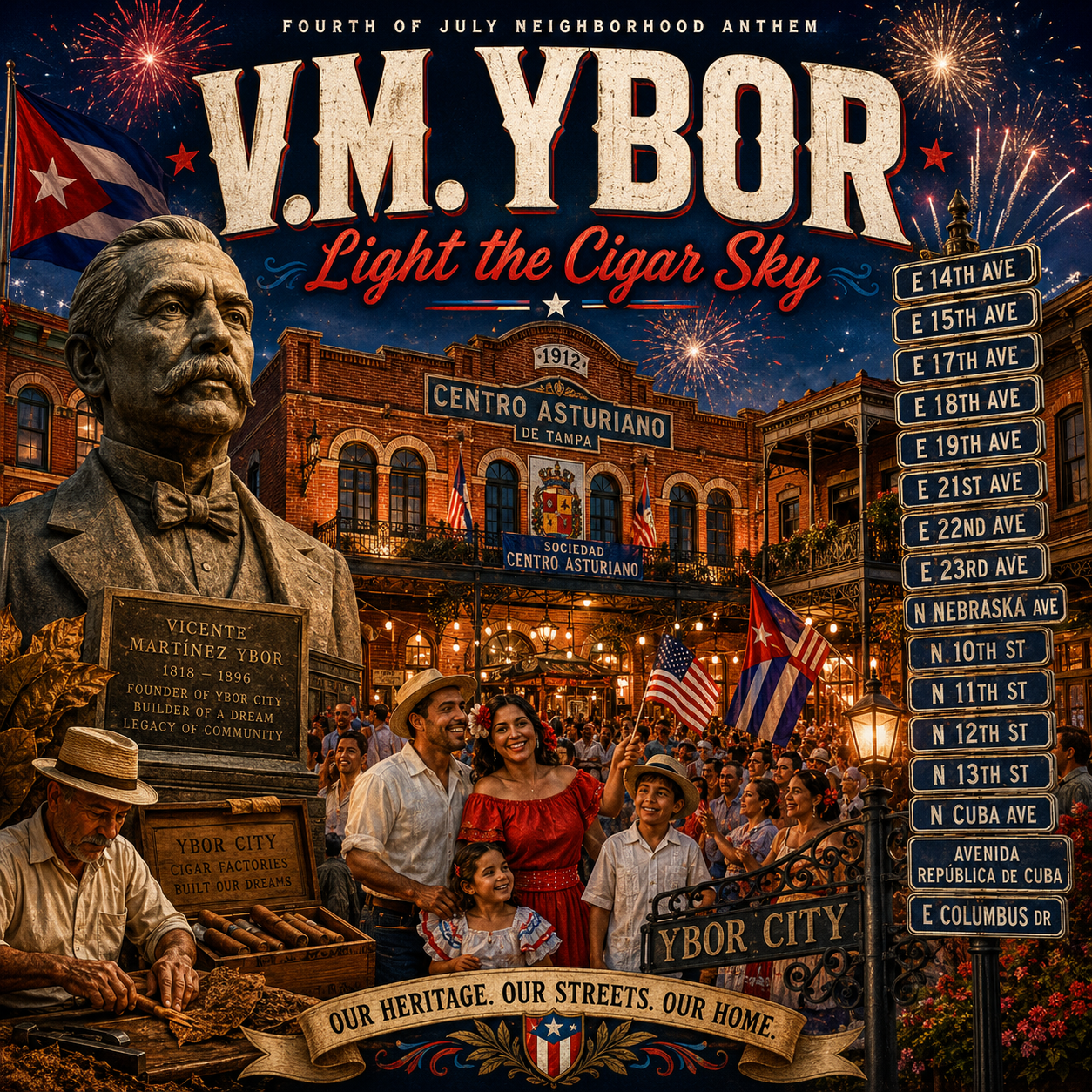
This Fourth of July, V.M. Ybor is celebrating more than fireworks. It is celebrating the hands that rolled the cigars, the families who crossed oceans searching for opportunity, the casitas that gave workers a place to call home, and the neighborhood spirit that helped transform Tampa from a small Gulf Coast town into a city known around the world.
The new neighborhood anthem, "V.M. Ybor, Light the Cigar Sky," is a tribute to that legacy. It is a song for the workers, the dreamers, the families, the historic streets, and the generations of residents who have kept V.M. Ybor's identity alive.
The Neighborhood Named for a Tampa Visionary
The "V.M." in V.M. Ybor stands for Vicente Martínez Ybor, the Spanish-born cigar manufacturer whose decision to move his business to Tampa changed the course of the city's history. In 1885, Martínez Ybor came to Tampa looking for a place to relocate his cigar operations. The city was still small, but it had several important advantages: affordable land, the warm humid climate needed to keep tobacco workable, and transportation links through Henry Plant's railroad and steamship system.
Martínez Ybor purchased land northeast of downtown Tampa and began building what would become Ybor City. Working alongside business partners and fellow cigar industry leaders, including Eduardo Manrara and Ignacio Haya, he helped create a company town that quickly became one of the world's most important cigar-manufacturing centers. That growth changed Tampa forever.
From Open Land to Cigar City
What began as scrubland soon became a neighborhood full of factories, homes, stores, social clubs, streetcars, and people from around the world. Cuban, Spanish, Italian, and other immigrant families came to Tampa for work in the growing cigar industry. They brought their languages, faith, food, music, traditions, skills, and determination.
Inside the factories, workers hand-rolled cigars that were shipped across the country and around the world. Outside the factories, they built lives. Families lived in small homes known as casitas, which gave cigar workers an opportunity to purchase a home close to where they worked. Children played in the streets. Neighbors gathered on porches. Families supported each other through hard work, celebrations, illness, and change. The cigar factories may have been the economic engine, but the people were the heart of the neighborhood.
More Than Cigars: A Community Built to Last
Vicente Martínez Ybor did not only build factories. He invested in the wider community through businesses and services that helped the growing neighborhood function. His interests included transportation, paving, insurance, gas, brick production, a brewery, and other ventures connected to the rapid growth of Tampa. He also supported homeownership, helping workers create stability for their families.
His original wooden cigar factory later became the first home of El Centro Español de Tampa, one of the city's earliest mutual-aid societies. These organizations were essential to immigrant communities, offering social connection, health support, cultural activities, and a place to turn when families needed help. The historic Centro Asturiano remains another powerful symbol of that community spirit. Its walls hold the story of a time when neighbors came together not only to celebrate, but to support one another. That is the kind of history that lives beyond a building. It becomes part of the neighborhood's identity.
Streets That Carry the History Forward
V.M. Ybor's streets carry the names and memories of the generations who have lived here. From East 14th Avenue to East 15th Avenue, East 17th Avenue, East 18th Avenue, and East 19th Avenue, the neighborhood is filled with blocks that connect old Tampa to the people living here today.
East 21st Avenue, East 22nd Avenue, East 23rd Avenue, North Nebraska Avenue, North 10th Street, North 11th Street, North 12th Street, North 13th Street, North Cuba Avenue, Avenida República de Cuba, and East Columbus Drive all form part of the neighborhood's daily rhythm. Streets such as East Adalee Street, East St. Clair Street, East Robles Street, and East Bryan Street are more than names on a map. They are the roads where families came home from work, where children grew up, where neighbors built relationships, and where a historic community continues to evolve. V.M. Ybor is close enough to the heart of Tampa to feel the city's momentum, but rooted enough to still carry the character of its earliest residents.
A Living Historic Neighborhood
V.M. Ybor sits just north of the better-known commercial core of Ybor City, but it has its own identity. It has long been a residential neighborhood where cigar workers, managers, accountants, business owners, and their families lived close to the factories and social clubs that shaped their lives.
Even after changes in the cigar industry caused many residents to move elsewhere in the mid-20th century, much of V.M. Ybor's historic framework remained. Many early homes, commercial buildings, and former cigar-related structures still stand. Some have been restored, some have found new uses, and many continue to remind residents that Tampa's history is not far away. It is right outside the front door.
A Fourth of July Song for the Workers, Families, and Dreamers
"V.M. Ybor, Light the Cigar Sky" was written as a Fourth of July anthem for the people who built this community. It honors the immigrant families who arrived with courage and skill. It honors the cigar workers who made Tampa a worldwide manufacturing force. It honors the homeowners who built lives in the casitas. It honors the community halls, the historic streets, and the pride that has survived through every generation.
The song's message is bigger than fireworks. It is about celebrating freedom through the ability to work, build, belong, raise a family, preserve culture, and create a future. When the sky lights up this Fourth of July, let the neighborhood sing it loud: V.M. Ybor, light the cigar sky. From the old casitas to the fireworks high, we carry the past when we light the night. From Columbus Drive to Twenty-Fifth Avenue, this neighborhood is home to you. 🇺🇸
Lyrics — V.M. Ybor, Light the Cigar Sky
[Intro – Spoken Over Drums and Distant Fireworks]
Before the skyline…
Before the highways…
Before Tampa became the city we know—
There were hands rolling tobacco.
There were families building homes.
There were dreams crossing oceans.
From Cuba.
From Spain.
From Italy.
To one patch of land northeast of Tampa.
Tonight, we honor the workers.
Tonight, we honor the families.
Tonight, we honor V.M. Ybor.
[Crowd Chant]
V! M! YBOR!
LIGHT THE CIGAR SKY!
V! M! YBOR!
FOURTH OF JULY!
[Verse 1 – The Beginning]
Eighteen eighty-five, the railroad rails were humming,
Henry Plant had opened up the road for something coming.
Tampa was still small then, dust roads in the heat,
But Vicente Martínez Ybor saw a city in the street.
Forty acres of scrubland where the wild grass blew,
He saw factory windows, heard a future breaking through.
With Eduardo Manrara and Ignacio Haya near,
They drew up streets and built a town for every dreamer here.
The tobacco came in fragrant from the islands and the shore,
Hands rolled every leaf with pride behind the factory door.
And the brick walls rose enormous, standing strong against the sky,
A city built on labor, hope, and families standing by.
[Pre-Chorus]
From the factory smoke—
Crowd: To the stars!
From the working hands—
Crowd: To our hearts!
From the old streets—
Crowd: To tonight!
V.M. Ybor, shine your light!
[Chorus – Big Crowd Sing-Along]
V.M. YBOR! LIGHT THE CIGAR SKY!
Raise your hands for the Fourth of July!
From the old casitas to the fireworks high,
We carry the past when we light the night!
V.M. YBOR! STAND UP PROUD!
Let the whole city hear us loud!
From Columbus Drive to Twenty-Fifth Avenue,
This neighborhood is home to you!
[Verse 2 – The Workers and the Casitas]
Cuban voices in the morning, Spanish songs at noon,
Italian kitchens filled with stories underneath the moon.
Managers, makers, accountants, families side by side,
Building more than cigars—they were building Tampa pride.
Little casitas lined the blocks, each porch a piece of home,
Children played on sidewalks while the grown folks carried on.
A doctor down the street, a neighbor at the door,
A helping hand when times were hard, a little something more.
They built social halls and mutual-aid societies,
Where the people could find comfort, strength, and dignity.
El Centro Español opened wide its doors for every friend,
A place for music, meetings, help, and hope that would not end.
[Pre-Chorus]
From the old front porch—
Crowd: To the street!
From the family table—
Crowd: To the beat!
From the factory floor—
Crowd: To the sky!
V.M. Ybor, rise tonight!
[Chorus]
V.M. YBOR! LIGHT THE CIGAR SKY!
Raise your hands for the Fourth of July!
From the old casitas to the fireworks high,
We carry the past when we light the night!
V.M. YBOR! STAND UP PROUD!
Let the whole city hear us loud!
From Columbus Drive to Twenty-Fifth Avenue,
This neighborhood is home to you!
[Verse 3 – Streets of the Neighborhood]
East Fourteenth, Fifteenth, Seventeenth strong,
Eighteenth and Nineteenth, sing the neighborhood song.
East Twenty-First, Twenty-Second, Twenty-Third in line,
Every block has history, every street can shine.
North Nebraska running north with the city moving fast,
North Tenth, Eleventh, Twelfth—holding onto the past.
North Thirteenth, North Cuba, República de Cuba too,
The old-world heartbeat still comes shining through.
Adalee and St. Clair, Robles in the sun,
Bryan Avenue remembers every family that has come.
East Columbus Drive keeps the neighborhood alive,
From the morning coffee smell to the Fourth of July.
[Verse 4 – Vicente Martínez Ybor]
Vicente Martínez Ybor, Tampa knows your name,
You brought more than factories—you brought a living flame.
A brewery, a hotel, an ice house and a line,
Gas, brick, insurance, streetcars moving through the town in time.
You gave workers chances to buy a home and stay,
To raise their children close and build a better way.
When the city gathered at your funeral in ninety-six,
They knew Tampa had been changed by every brick you fixed.
From the first cigar factory to the Riverwalk today,
Your name is in the streets and in the stories people say.
Not just a man who built a business, but a vision standing tall,
A builder of a community that helped uplift us all.
[Pre-Chorus – Choir Rising]
From the tobacco leaves—
Crowd: To the flame!
From the past—
Crowd: To the name!
From the families then—
Crowd: To us now!
V.M. Ybor, show us how!
[Bridge – Centro Asturiano and Community]
At Centro Asturiano, those old walls still stand,
Holding music, history, and memories in their hands.
A landmark for the people, a place where voices grew,
Where community meant showing up and seeing each other through.
At La Segunda Bakery and Café, the bread is warm and sweet,
A familiar kind of comfort that brings generations to meet.
At Elevensees, neighbors gather, stories fill the air,
The past and present meet again when the community is there.
From the corner shops to the porches,
From the streetlights to the sky,
There is something in this neighborhood
That makes you want to testify.
[Call and Response Breakdown]
Lead: Who built this city?
Crowd: THE WORKERS DID!
Lead: Who built these homes?
Crowd: THE FAMILIES DID!
Lead: Who kept the culture alive?
Crowd: THE PEOPLE DID!
Lead: What do we shout when the fireworks fly?
Crowd: V.M. YBOR, LIGHT THE CIGAR SKY!
Lead: From the old cigar smoke to the city lights bright?
Crowd: V.M. YBOR, WE RISE TONIGHT!
[Final Chorus – Full Choir, Repeat Twice]
V.M. YBOR! LIGHT THE CIGAR SKY!
Raise your hands for the Fourth of July!
From the old casitas to the fireworks high,
We carry the past when we light the night!
V.M. YBOR! STAND UP PROUD!
Let the whole city hear us loud!
From Columbus Drive to Twenty-Fifth Avenue,
This neighborhood is home to you!
V.M. YBOR! LIGHT THE CIGAR SKY!
For the hands that worked and the dreams that survived!
For the families who came and made Tampa rise,
V.M. Ybor—light the sky!
[Outro – Fireworks, Choir, and Crowd]
V! M! Ybor!
Light the cigar sky!
Cigar City!
Fourth of July!
Casitas!
Stand up proud!
V.M. Ybor!
Say it loud!
For the workers.
For the families.
For the dreamers.
For the neighborhood.
V.M. Ybor—forever alive.