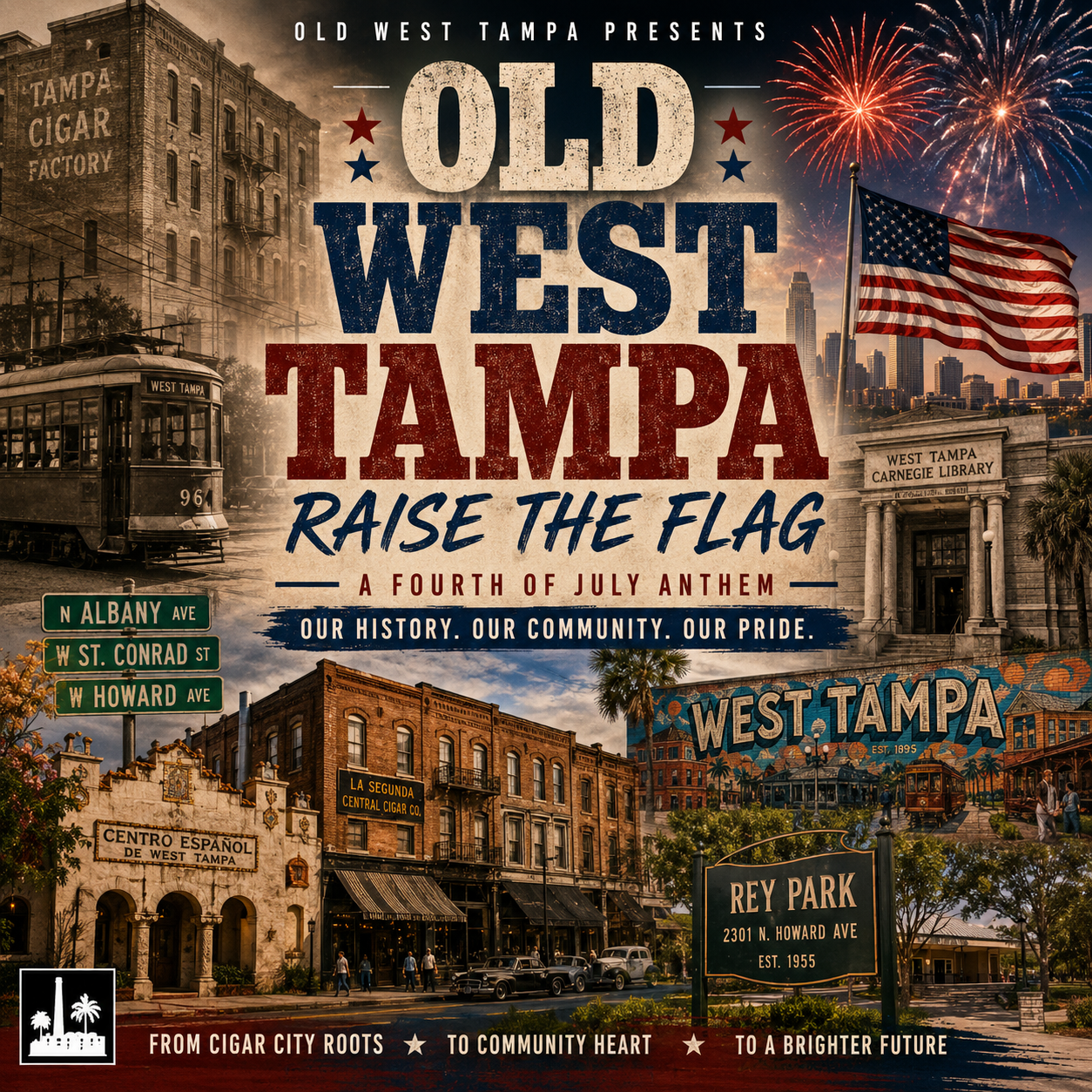
West Tampa is more than a neighborhood just northwest of downtown. It is one of Tampa's strongest stories of determination, immigration, industry, family, and pride.
This Fourth of July, we are celebrating Old West Tampa with a neighborhood anthem: "Old West Tampa, Raise the Flag." The song honors the workers who built the cigar factories, the families who filled the porches and brick streets, the clubs and libraries that brought people together, and the new generation continuing the legacy today. West Tampa has always known how to work hard, gather close, and celebrate big.
A City Born From Vision
The roots of West Tampa go back to the 1890s, when Scottish immigrant and attorney Hugh C. Macfarlane saw opportunity on land west of the Hillsborough River. At the time, Tampa's cigar industry was booming in Ybor City, but Macfarlane believed there was room for another thriving community. He purchased land, promoted the area to cigar manufacturers, helped establish transportation links, and built a bridge over the river to connect the growing town with downtown Tampa.
The vision worked. Factories opened. Workers arrived. Streets filled with homes, stores, restaurants, churches, and community organizations. In 1895, West Tampa officially became its own incorporated city. For a time, West Tampa was one of Florida's most active and important communities.
The Heart of Cigar City
West Tampa became a major cigar-manufacturing center, drawing Cuban, Spanish, and Italian immigrants who brought their skills, traditions, food, language, and culture with them. The factories were the economic engine, but the people were the real heartbeat.
Workers lived close to the factories in shotgun homes, rowhouses, and bungalows. Neighbors could walk to work, visit family, shop nearby, attend social gatherings, and build lives only blocks apart. The brick cigar factories became symbols of opportunity. Their tall windows, strong walls, and distinctive architecture still tell the story of an era when cigar workers helped shape Tampa into the city it is today. Old West Tampa was never just a place to make cigars. It was a place to make a life.
Streets That Carry the Story
Walk through West Tampa today and the history is still there. Along N Albany Avenue, W St. Conrad Street, W Beach Street, W Pine Street, W Walnut Street, and W Chestnut Street, the neighborhood's street grid carries generations of memories. These are streets where families raised children, neighbors sat outside on porches, workers returned home after long factory shifts, and community traditions were passed down.
Every block has its own story. Some streets hold restored homes. Others still carry the character of old West Tampa through bungalow roofs, wood-frame houses, historic sidewalks, and the remaining industrial buildings that once powered the neighborhood.
The Institutions That Held the Community Together
West Tampa's growth was not only built around factories. It was built around people helping people. The Centro Español de West Tampa became one of the neighborhood's major gathering places. It offered social events, theater, medical support, and a place for immigrant workers and families to connect. The Sicilian Club also played an important role in the cultural life of the neighborhood, serving as a place where families could celebrate heritage, gather for events, and support one another.
Then there is the West Tampa Carnegie Library on Howard Avenue. Built in 1913, the library was made possible through land donated by cigar manufacturer Angel Cuesta and funding from Andrew Carnegie's library program. More than a century later, it still stands as a reminder that education, information, and opportunity belong in every community. The library is more than a building. It represents the idea that every child growing up in West Tampa deserves a chance to learn, dream, and build something bigger.
Rey Park: A Community Gathering Place
At 2301 N. Howard Avenue, Rey Park has been an important neighborhood gathering place since the 1950s. Named for former West Tampa mayor Peregrino Rey, the park and recreation center have hosted generations of residents. Teen nights, pool tournaments, bridge games, cooking classes, youth programs, and fitness activities all made Rey Park part of everyday neighborhood life.
Now the park is entering a new chapter. The redevelopment of Rey Park will bring a new community center, basketball courts, a walking loop, shaded playgrounds, a covered porch, and outdoor fitness space. It is a major investment in the families who live in and love West Tampa. The neighborhood's past is being honored too. The well-known 1984 mural by local artist Carl Cowden III will be preserved through a new display inside the rebuilt center. That is what West Tampa does best: it builds forward without forgetting where it came from.
From Independent City to Tampa Legacy
West Tampa remained its own city until January 1, 1925, when it was annexed into Tampa. The boundary lines changed, but the identity did not. West Tampa remains one of Tampa's most culturally important communities. Its history lives in the remaining cigar factories, the social clubs, the old homes, the street names, the businesses, and the families whose roots run deep here.
Today, the neighborhood continues to evolve. Historic factories and storefronts are being restored. New businesses are opening. Community spaces are being improved. Yet the spirit of the old city remains. It is still a place built by working people, proud families, and a culture that refuses to be forgotten.
A Fourth of July Tribute to West Tampa
The Fourth of July is about freedom, family, and the idea that people can build a better future together. That message fits West Tampa perfectly. This community was built by immigrants who crossed oceans, workers who gave long hours in the factories, families who made homes near the river, and leaders who believed in creating opportunity.
So when fireworks rise over Tampa this Fourth of July, Old West Tampa has every reason to celebrate. Celebrate the cigar workers. Celebrate the families. Celebrate the historic streets. Celebrate the clubs, library, parks, porches, and brick buildings. Celebrate the past that gave this neighborhood its voice and the future that is still being written.
Old West Tampa, raise the flag high. Fireworks shining in the Fourth of July sky. From Howard Avenue to the river's edge, we carry our history and honor the pledge. Happy Fourth of July, West Tampa. Your history is powerful, your culture is alive, and your pride continues to light up Tampa. 🇺🇸